
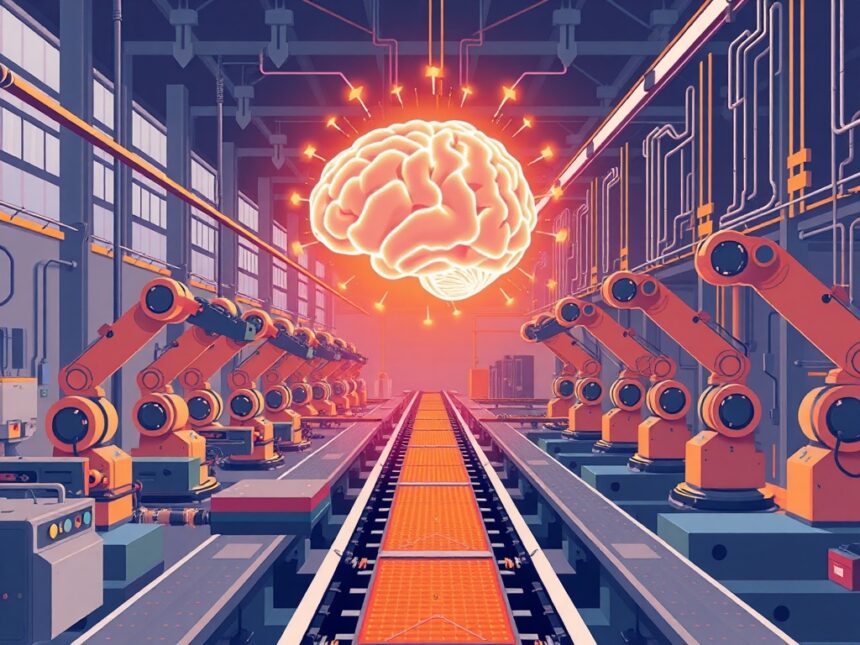
When Eclipse Ventures planted a $6.5 million seed in a little-known semiconductor company called Cerebras back in 2016, the conventional wisdom in Silicon Valley was clear: real money lived in software, SaaS, and the cloud. Hardware was capital-intensive, slow, and frankly, unpopular. Nine years and $147 million in total investment later, that single bet returned $2.5 billion when Cerebras went public this week — a 17-fold windfall that has the entire venture industry reassessing what “tech” actually means.
The Vibe Code Reality Check
Eclipse founder Lior Susan put it bluntly at a recent StrictlyVC event: what made a company defensible five years ago looks very different today. “The real moat in software is gone,” he said. “You can vibe code pretty much whatever you want.” With AI tools like Claude Code and GPT-5 enabling anyone to spin up a functional app in hours, the barriers that once protected SaaS startups have evaporated. The message for founders is stark — if your only competitive advantage is your codebase, you’re already commoditized.
What you cannot vibe code, Susan noted, is a semiconductor wafer fab. You cannot prompt your way into a clean room, a supply chain for rare earth materials, or a robotics manufacturing line. Those require capital, physical infrastructure, and deep domain expertise — precisely the kind of moat that AI cannot erode. And that is where the smart money is heading.
85% of the Economy Is Still Physical
The core thesis driving Eclipse’s strategy is both simple and profound: roughly 85% of global GDP is tied to the physical world. Software touches it, optimizes it, and layers efficiency on top — but software alone does not generate power, move freight, build houses, or manufacture chips. For decades, venture capital treated those sectors as too slow or too capital-intensive. That calculus has flipped.
Eclipse’s portfolio companies raised nearly $15 billion from outside investors last year, and momentum accelerated to $4.5 billion in Q1 2026 alone. The numbers are staggering: $1.2 billion for autonomous driving startup Wayve, $650 million for space defense company True Anomaly, $270 million for robotics firm Bedrock Robotics, and $200 million for Oxide Computer. Crucially, Eclipse was the Series A investor in all four. This is not a diversified portfolio gamble — it is a conviction bet on a structural shift in where value is created.
Five Forces, One Moment
Susan argues that the current wave is not purely an AI story, though AI plays a role. What makes this moment historically unique is the alignment of five forces: technology maturity, available capital, customer demand, talent migration, and government policy. “This is the first time I believe in America ever, from Henry Ford and Carnegie, those five forces are aligned,” Susan said.
Consider the talent angle. For the better part of a decade, the brightest engineering graduates headed to consumer apps, ad platforms, and fintech. Today, the most exciting work is happening in robotics, energy storage, semiconductor design, and defense tech. Engineers want to build things that exist in the real world, not just optimize ad click-through rates. At the same time, the U.S. government is actively encouraging these industries through CHIPS Act subsidies, defense contracts, and favorable regulatory frameworks.
This convergence matters for startup founders because it signals a durable trend rather than a hype cycle. Physical-world startups require more capital to get off the ground, but they build genuine defensibility. A robotics company with proprietary hardware, ten years of manufacturing data, and deep relationships with industrial customers cannot be disrupted by a three-person team with a chatbot subscription.
The Takeaway for Founders
The Eclipse story offers a strategic lens for any founder thinking about where to build. If your startup’s value depends primarily on software that an LLM could replicate within 18 months, you need a hard look at your moat. The big exits — and the big returns — are increasingly happening in companies that touch atoms, not just bits.
That does not mean every founder needs to build a chip fab. But it does mean that combining software intelligence with physical-world differentiation — whether through hardware design, supply chain integration, regulatory expertise, or proprietary data from physical operations — is becoming the defining competitive advantage of this decade. The software gold rush was real, but the physical world is where the next fortunes will be built.
This article was inspired by reporting from Marina Temkin at TechCrunch. Read the original piece here.