
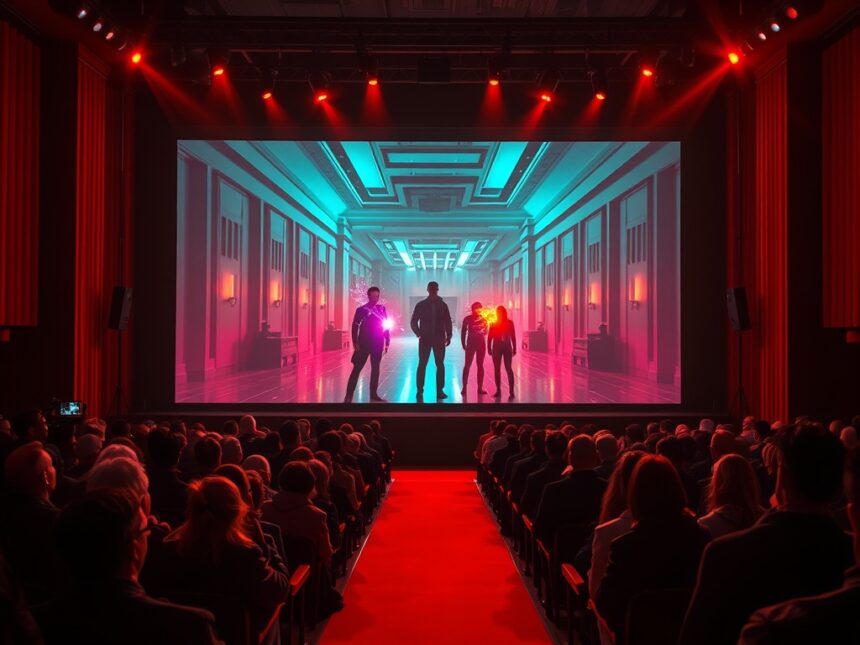
The 79th Cannes Film Festival has seen its share of cinematic milestones — but this year, one of the most talked-about premieres wasn’t backed by a major studio or a nine-figure budget. It was generated line by line, frame by frame, by an AI model tucked inside ByteDance’s cloud infrastructure, and it only took two weeks to make.
Hell Grind, a 95-minute sci-fi feature produced by US-based AI studio Higgsfield and powered by ByteDance’s Seedance 2.0 video generation model, premiered at Cannes on Thursday to an audience that didn’t quite know what to expect — and left with a lot to think about. The film follows four street kids who stumble across a mysterious artifact, awaken a dark force, and gain superpowers in the process. It sounds like a standard genre premise, but the production numbers are anything but standard.
<2>A fraction of the cost, a fraction of the time
The film was completed by a team of just 15 people in 14 days, with a total budget under $500,000. To put that in perspective, a traditionally produced sci-fi feature of similar scale typically runs tens of millions of dollars and involves hundreds of crew members working over several months. Even modest indie genre films often land in the $5–20 million range.
That kind of compression doesn’t just change the economics of one movie — it changes the entire calculus of who gets to make feature films at all. For startup founders building in the creative technology space, this is the kind of inflection point that opens entirely new markets.
<2>Why long-form video was the last frontier
Until now, AI video generation has been stuck in short-form purgatory. Tools like Runway, Pika, and OpenAI’s Sora can produce impressive 15-to-30-second clips, but stringing together tens of thousands of coherent shots for a feature film has been a technical nightmare. Faces change between frames. Scenes lose visual continuity. Characters don’t look the same from one minute to the next. Seedance 2.0 appears to have solved enough of those continuity problems to sustain a 95-minute narrative without breaking immersion — at least, according to attendees who’ve seen early cuts.
Director Chuck Russell, who watched an early version of the film, reportedly said he found himself genuinely empathizing with the AI-generated characters — something he described as rare in AI cinema. That’s a meaningful signal. If the emotional ceiling for AI-generated storytelling is rising, the market for AI-native entertainment could expand far beyond the novelty-driven experiments we’ve seen so far.
<2>What this means for startup founders
There are three takeaways here that map directly onto startup strategy:
1. The bottleneck is shifting from production to direction. When a feature film can be made by 15 people in two weeks, the limiting factor is no longer budget, headcount, or access to equipment. It’s creative vision. This is exactly the pattern we saw in software when cloud infrastructure replaced physical data centers — the barrier to entry collapsed, and the winners became the people with the best ideas, not the biggest checkbooks. Startups building in media, advertising, education, and training should be asking: what does your industry look like when production costs drop by 90 percent?
2. Infrastructure players will capture the platform value. ByteDance didn’t make Hell Grind — it provided the model through Volcengine, its cloud division. Luc Besson’s SEEN studio is reportedly already in talks to use Seedance 2.0 for a new animated project. The real value in the AI video stack may not be in individual productions but in the underlying platform that enables them. For founders, the question is whether to build on existing infrastructure or invest in proprietary models that offer differentiation.
3. Incumbent displacement is coming faster than expected. If a 95-minute feature can be generated with AI today, the workforce implications for mid-tier production roles, VFX houses, and post-production studios are significant. That doesn’t mean human creators disappear — it means the roles that survive will be the ones centered on taste, curation, and creative direction rather than technical execution. Startups that can help traditional media companies navigate this transition (training, tooling, workflow integration) have a clear wedge into a nervous but well-funded market.
<2>The bigger picture
Hell Grind may not win the Palme d’Or, and it may not be a cinematic masterpiece by traditional standards. But that’s largely beside the point. What happened at Cannes this week is that the question shifted from “can AI make a feature film?” to “what happens now that it can?” For startup founders building in the AI creative space, that’s the sound of an industry rewriting its rules — and the early movers are already placing their bets.
Based on reporting by Jessie Wu at TechNode.