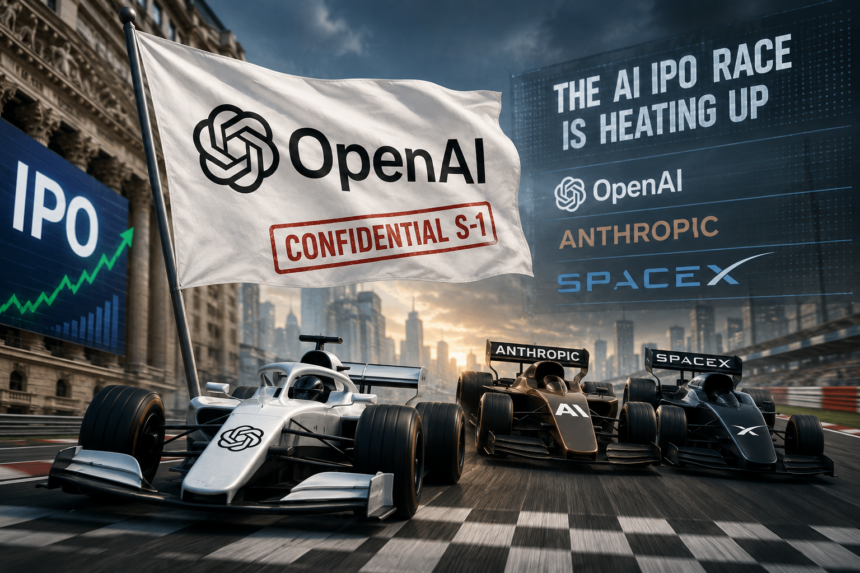
OpenAI has confidentially filed for an initial public offering with the Securities and Exchange Commission, the company announced Monday — joining Anthropic, which filed a week earlier, and Elon Musk’s SpaceX, which kicked off its roadshow last week. The trifecta of mega-IPOs is shaping up to be one of the defining financial moments of the AI era.
What we know about the filing
OpenAI submitted a confidential S-1, a standard process that lets the company submit financials to regulators for review before full public disclosure. The company, valued at $852 billion post-money after its March funding round, is eyeing a potential public listing as soon as the fourth quarter of 2026. OpenAI said Monday it hasn’t decided on timing yet.
“We recently submitted a confidential S-1. We expect it to leak so we’re just announcing it,” the company wrote in a blog post. “We have not decided on timing yet; it may be a while because there are things we want to do that are likely easier as a private company.”
OpenAI is working with Goldman Sachs and Morgan Stanley on the filing — the same two banks topping SpaceX’s IPO paperwork. The company also plans to facilitate a tender offer allowing employees to sell shares at the latest $852 billion valuation, providing some near-term liquidity relief.
The bigger picture: A race to market
OpenAI’s filing comes just a week after Anthropic confidentially filed its own S-1, hot off a $965 billion valuation that actually topped OpenAI’s. Meanwhile, SpaceX — now merged with xAI — kicked off its IPO roadshow last week, listing OpenAI, Anthropic, and Google as key AI competitors in its filing.
Depending on how SpaceX’s offering is received, Anthropic and OpenAI could find themselves racing to beat each other to market amid the massive amounts of capital they’re trying to raise. All three companies represent a generational shift in how Wall Street values AI-infused businesses.
The “third phase” of OpenAI
CEO Sam Altman used Monday to also outline what he called the “third phase” of OpenAI: from research lab to product company to — now — making advanced AI abundant, affordable, and safe for everyone. The company has been shuttering fringe projects like the short-form video app Sora and pouring resources into its enterprise business and coding assistant Codex, which is directly competing with Anthropic’s Claude Code.
“The economy is beginning to reshape around AI,” Altman wrote in a blog post. “The central question now is how to make advanced AI abundant, affordable, safe, useful, and easy enough for every person and organization to benefit from it.”
Altman posted on X in April that “feels like codex is having a chatgpt moment,” signaling the company’s heightened focus on developer tools and enterprise revenue.
The numbers game
OpenAI now supports more than 900 million weekly active users on ChatGPT, but the company faces intense financial scrutiny. It has raised over $180 billion in funding and is still burning through cash as it secures compute and builds out infrastructure to train and run increasingly large AI models.
CFO Sarah Friar told CNBC in April that it’s “good hygiene” for a business of OpenAI’s size to “look and feel and act” like a public company. IPO or not, the company is clearly preparing for life in the public eye.
What’s next
The dueling IPO efforts come less than a month after Musk and Altman emerged from a bruising three-week court battle, where an advisory jury ruled Musk waited too long to bring breach-of-contract claims. Musk has vowed to appeal, saying the decision was “on a calendar technicality.”
For now, all eyes are on SpaceX’s IPO reception — it will set the tone for what could be the biggest wave of AI public offerings in history. OpenAI, Anthropic, and Musk’s combined empire are all racing toward a finish line that will reshape the tech investing landscape for years to come.
Source: CNBC