
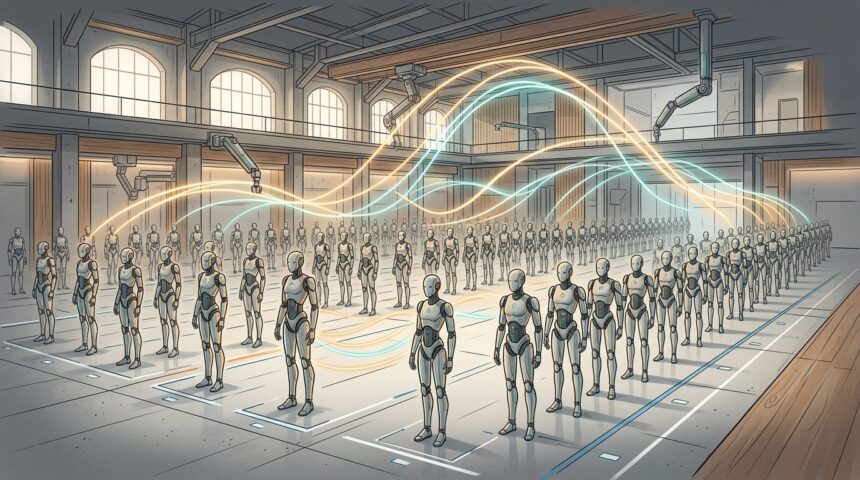
China is treating robot training like factory capacity. By the end of June, more than 70 embodied-AI training grounds were operating nationwide, with another 46 under construction or planned, according to the China Academy of Information and Communications Technology. The sites span more than half of the country’s provincial-level regions.
The facilities give robotics developers physical environments for collecting real-world data, training models and testing machines – the ground-level infrastructure behind China’s humanoid push. Industrial manufacturing is the most common application, showing up in 86% of the grounds.
The main clusters sit in the Yangtze River Delta, the Beijing-Tianjin-Hebei region and the Pearl River Delta, the country’s three technology heartlands. The report was relayed by IT Home, a Chinese tech outlet.
Rather than leaving data collection to individual labs, the state and industry are standing up dedicated facilities at scale. That hands Chinese robotics firms a systematic advantage in the expensive, messy work of teaching machines to move, grasp and navigate the physical world.
It also marks where the embodied-AI race is being decided. Western startups largely train robots in-house or in university labs; China is industrializing the process. As humanoids move from demos toward deployment, whoever controls the training grounds may control the pace.