
TechflierTechflierTechflier
  • Home
  • News
  • Features
  • Spotlight
  • About
    • Mission
    • Services
    • Contact
  • Newsletter
  • Shop
    • All Items
    • By Category
      • Bags
      • T-Shirts
    • Cart
Search
© 2025 Techflier. All Rights Reserved.
Reading: Eka Robotics feels its way to a $1.45B valuation with $150M
Share
Font ResizerAa
TechflierTechflier
Font ResizerAa
  • Home
  • News
  • Features
  • Spotlight
  • About
  • Newsletter
  • Shop
Search
  • Home
  • News
  • Features
  • Spotlight
  • About
    • Mission
    • Services
    • Contact
  • Newsletter
  • Shop
    • All Items
    • By Category
    • Cart
Have an existing account? Sign In
Follow US
© 2025 Techflier. All Rights Reserved.
News

Eka Robotics feels its way to a $1.45B valuation with $150M

A Cambridge startup bets that force sensors, not cameras alone, are what finally makes robot hands useful on real production lines.

Techflier Staff
Last updated: October 22, 2026 2:09 am
Techflier
Share
SHARE

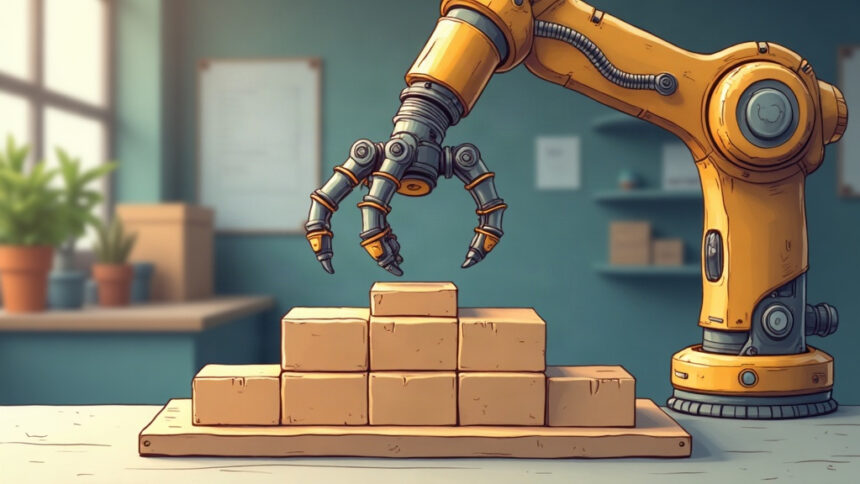
A robot hand that only sees is guessing about weight. Eka Robotics has built one that feels, and investors just handed it $150M to scale the idea.

Contents
Faster than a human baselineThe open question

The Cambridge, Massachusetts startup raised a Series A at a reported $1.45B valuation, led by Andreessen Horowitz and F-Prime, a Fidelity Investments affiliate. Obvious Ventures and E14 Fund, which co-led a $11M seed in May 2025, returned. Total funding now sits near $161M.

Eka calls its approach a vision-force-action model. Force sensors inside a custom gripper report how firmly an object is held, so the system can adjust mid-task when something starts to slide, rather than failing and retrying.

Faster than a human baseline

The company says its robots now pick unfamiliar objects at roughly 1,500 operations per hour, against a human benchmark of about 600. Grippers handle items up to one kilogram with a success rate above 95%, cost under $1,000 each, and are rated for 5 million duty cycles, short of the 20 million typical industrial arms sustain.

Pilots are running with unnamed industrial customers on pick-and-place and wire handling, the sort of dull, repetitive work packing strawberries or assembling server racks for GPUs.

The open question

Kris Hauser, a professor at the University of Illinois Urbana-Champaign, told TechCrunch the demo carried real wow factor because the robot adapted across many objects without retraining. He also asked whether the system survives a year on an assembly line without failing, and whether it generalizes past picking and placing.

That is the right question. Manipulation demos have impressed for a decade; factory floors are less forgiving. Eka’s founders, Pulkit Agrawal of MIT’s Improbable AI Lab and Tuomas Haarnoja from Google DeepMind, are betting on force data being the difference.


Rainmaker banks $100M to make cloud seeding mainstream
British-U.S. startup Build raises €7.4 million for agentic real estate platform
A tiny 27B-parameter agent beats frontier models at paper replication
Jeff Dean exits Google to launch science AI startup Discovery Loop
Apple trade secret lawsuit puts OpenAI’s phone plans in legal jeopardy
TAGGED:Andreessen HorowitzdexterityEka Roboticsfunding roundsphysical AIrobot manipulation
SOURCES:SiliconANGLE
Share This Article
Facebook Copy Link Print
Previous Article Ex-OpenAI research chief opens Arda with $232M for factory lines
Next Article Legora leaps to $8.8B as corporate legal teams sign on

Get Some Gear


Quick Links

  • News
  • Features
  • Spotlight
  • Newsletter
  • Store

About Techflier

  • About Techflier
  • Services
  • Contact Us
  • Privacy
  • Legal

Indices

TechflierTechflier
Follow US
© 2026 Techflier. All Rights Reserved.
Welcome Back!

Sign in to your account

Username or Email Address
Password

Lost your password?