
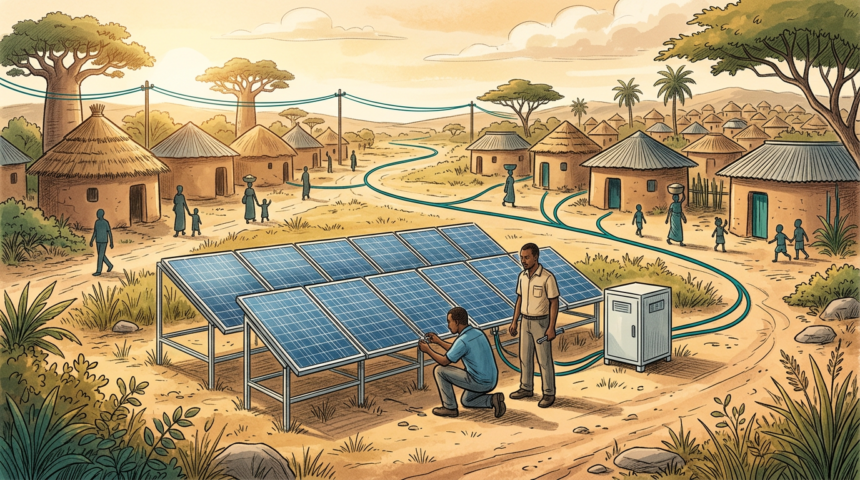
Okra Solar has taken a $7M debt facility from British International Investment, the UK development finance institution, in a bet that working capital – not technology – is what limits distributed energy in Nigeria.
The startup, founded in 2016, wires neighbouring homes and businesses into shared mesh grids: solar generation, battery storage and smart controls that share power across a cluster. It delivers more capacity than a standalone solar home kit while needing far less civil work than a conventional mini-grid. Roughly 13,000 households are connected today, backed by more than 2.3MW of installed capacity.
Ordering batteries before the customer signs
The bottleneck Okra describes is procurement timing. Without flexible capital it ordered components only after a project closed, in batches of a few thousand units, waiting months for delivery. Chief executive Afnan Hannan says the facility lets the company buy batteries and PV equipment upfront and in volume, roughly halving delivery time from four months to about two.
The capital should fund equipment for around 150,000 additional connections, a more than tenfold jump, with the potential to reach 750,000 people. Faster installs also help developer customers qualify sooner for results-based grant payments under DARES, Nigeria’s rural electrification programme backed by the World Bank.
Proving the model pays
BII’s Geoffrey Manley says the aim is to demonstrate that mesh grids are commercially viable at scale. Okra has raised equity before; this round is structured as debt.