
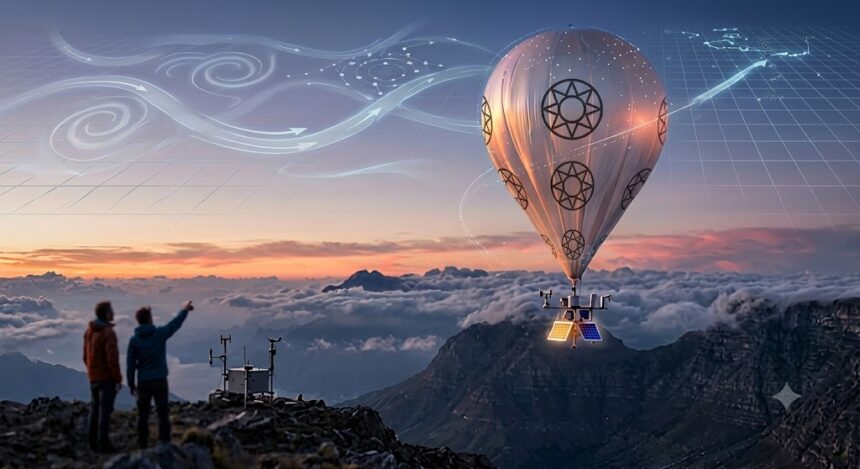
A group of Stanford students who started by building better weather balloons in 2019 has quietly accomplished something that billion-euro government agencies have spent decades perfecting: more accurate weather forecasts.
WindBorne Systems, an AI weather startup based in Palo Alto, today released the sixth version of its WeatherMesh forecasting model, and the results are turning heads in the meteorology world. The company says WeatherMesh-6 is now more accurate than both traditional physics-based forecasts and AI models produced by the European Centre for Medium-Range Weather Forecasts (ECMWF) — the intergovernmental organization widely regarded as the gold standard in global weather prediction.
“WeatherMesh-6 is as accurate five days out as a traditional forecast is the day before,” WindBorne chief product officer Kai Marshland told TechCrunch, particularly when it comes to surface temperature measurements.
That is a staggering leap. Traditional forecasting models rely on supercomputers running complex physics simulations — expensive, slow, and limited to producing forecasts every six hours. WindBorne’s AI model, by contrast, generates fresh predictions every single hour at a resolution of 3 kilometers within the continental United States.
<2>The data advantage
The key insight behind WindBorne’s rapid improvement is something every startup founder should internalize: better data beats better algorithms.
Most AI weather models — including those from Google DeepMind and other major labs — depend on datasets produced by ECMWF and the U.S. National Oceanic and Atmospheric Administration (NOAA). They are essentially learning from the same textbooks. WindBorne, on the other hand, collects its own data from a fleet of roughly 400 balloons in flight at any given time, launched from 15 sites around the globe.
“I don’t understand, personally, the business model of being an AI-based weather company without a dataset advantage,” WindBorne CEO John Dean said.
The company spent a year re-architecting its transformer-based model to directly ingest sensor data from its balloons and other sources instead of relying on ECMWF’s initial conditions. The result is a model that is increasingly independent of the very government systems it is outperforming.
“When we started doing data assimilation, we were still very heavily reliant on ECMWF,” Dean said. “I predict today, if we removed ECMWF’s initial conditions, we would actually still do pretty good.”
<2>From weather balloons to deep learning
WindBorne’s journey illustrates a pattern increasingly common in climate tech: hardware-enabled AI startups. The company began by selling better weather balloon data, but the 2022 arrival of deep learning forecasting models showed the founders they could capture far more value by building their own predictive model on top of their proprietary data pipeline.
That vertically integrated approach — own the sensors, own the data, own the model — creates a moat that pure-play AI companies struggle to replicate.
The company has raised $25 million in venture funding at a reported $85 million valuation as of 2024. It already sells balloon data to NOAA, the U.S. Air Force, and the U.S. Navy, while also providing forecasts to investors and commodity traders. But Dean says the company is deliberately resisting the temptation to build a traditional SaaS product, mindful of how quickly the information landscape is shifting.
“I’m not trying to invest a massive team into building a SaaS product, if the way people want consumer information two years from now is through an agent,” he said.
<2>What this means for founders
WindBorne’s trajectory offers a clear lesson for climate tech and AI startups alike. In markets where incumbents are government agencies or legacy institutions, a vertically integrated data advantage combined with modern AI architecture can close a gap that once seemed insurmountable. The ECMWF’s decades-long dominance was built on superior data assimilation, not superior modeling — and WindBorne showed that a lean startup with a hardware edge could leapfrog both.
Weather forecasting is a $7 billion global market, and the downstream industries it touches — agriculture, insurance, logistics, energy trading — are worth trillions. If WindBorne can maintain its accuracy lead while expanding coverage, the company could become an acquisition target for the very tech giants whose models it is currently outperforming, or emerge as a rare climate tech IPO candidate.
Either way, the message is clear: the era of AI beating institutional models is here, and it started with balloons.
Source: TechCrunch