
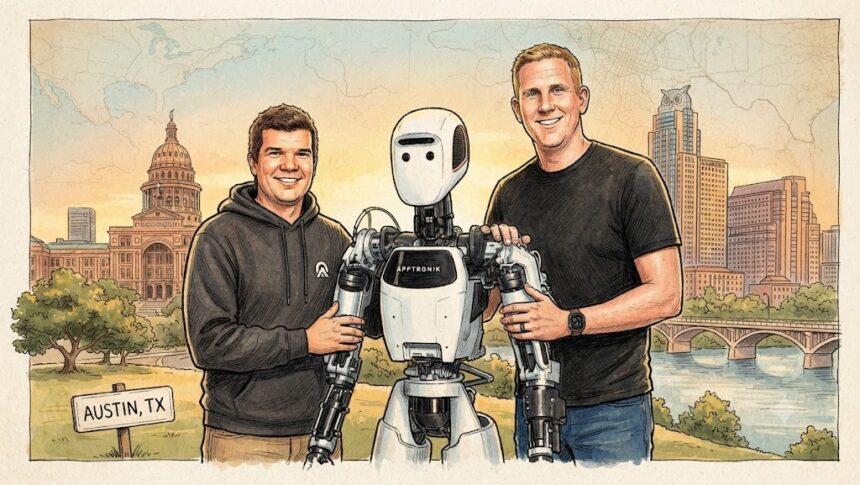
Before humanoid robots can clock in at factories and warehouses, they have to go to school. Apptronik, the Texas-based startup backed by Google DeepMind and Mercedes-Benz, has opened a nearly 90,000-square-foot training facility in Austin called Robot Park, where its Apollo humanoids practice real-world tasks under human supervision.
The facility runs seven days a week. Apollo robots practice loading boxes onto conveyor belts, sorting toys into bins, and other manual tasks while operators stand beside them guiding and monitoring each movement. The data generated from these sessions feeds into the AI models that act as the robots’ brains — a deliberate strategy to solve one of the biggest bottlenecks in humanoid development: the shortage of real-world training data.
“Just like you have a factory to build robots, we have a data factory to generate the kind of data we need,” said Jeff Cardenas, Apptronik’s cofounder and CEO. “This is a robot learning playground.”
Apptronik spun out of the Human-Centered Robotics Laboratory at the University of Texas in 2016, commercializing technology developed during the DARPA Robotics Challenge. The startup has raised roughly $1 billion and is valued at more than $5.5 billion. Mercedes already uses Apollo robots in its factories for tasks like gathering components and tools, while Google DeepMind uses the platform to improve its Gemini Robotics AI models.
The current model, Apollo 2, stands about 6 feet tall, runs for four hours on a single charge, and can lift 55 pounds with both hands. Unlike most humanoid companies building only walking robots, Apptronik has both legged and wheeled versions of Apollo. Cardenas expects wheeled robots to deploy sooner because they’re safer and more power-efficient, but sees legged humanoids as the longer-term bet since they can eventually do anything a human can physically do.
Cardenas draws a parallel to the early personal computer era. “Humanoids are the personal computer of our time, and if you believe that’s true, we’re in the early ’80s,” he said. “We’re in the word-processing, spreadsheet phase of the game.”
Apollo 3, the commercial version Apptronik plans to sell to customers, is in development. As competitors like Figure AI ($39B valuation), Agility Robotics (headed for a public listing), and 1X (planning 10,000+ home humanoids this year) push toward commercial deployment, Apptronik’s data-first approach at Robot Park could give it a critical edge in the race to make humanoids actually useful on the job.
Source: Business Insider