
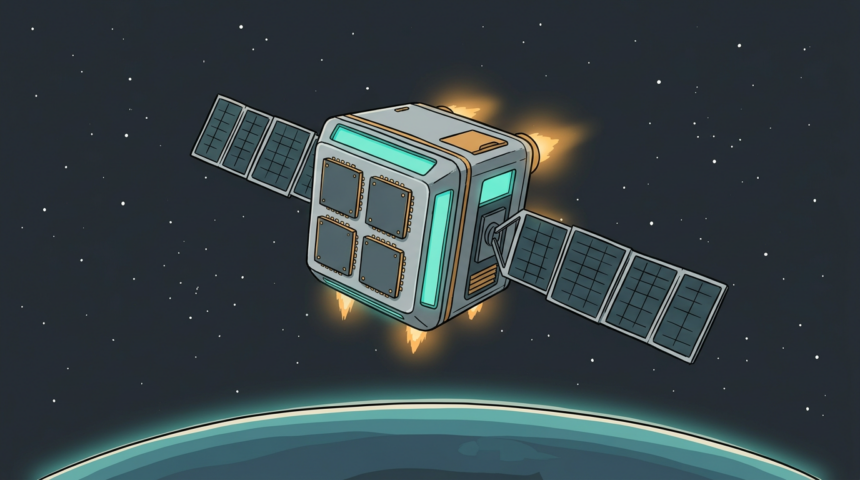
Google plans to send its first experimental AI satellite into low Earth orbit on October 1, testing whether the chips that power terrestrial data centres can survive above the atmosphere.
The refrigerator-sized spacecraft, called MVP, carries four of Google’s tensor processing units and is due to run Gemini workloads. It will ride a SpaceX Falcon 9 as part of the Transporter-18 rideshare mission, built with satellite imaging company Planet, and will gather data on how the hardware handles launch stress, radiation and extreme temperature swings.
Solar panels on the prototype should generate roughly one kilowatt, a rounding error beside the megawatts a conventional data centre draws. Google is not chasing commercial compute yet. The flight is a learning mission ahead of a planned 2027 milestone to launch two prototype satellites, work now pulled several months forward.
The project, unveiled in November 2025, sits inside a small but widening race. SpaceX has outlined plans for orbital AI data centres and filed with US regulators for a satellite constellation, discussing an initial architecture rated at about 120 kilowatts of sustained compute. Google’s prototype, notably, is reaching orbit aboard a rival’s rocket.
The pitch is a future where AI capacity escapes strained power grids, land limits and water-hungry cooling on Earth.