
TechflierTechflierTechflier
  • Home
  • News
  • Features
  • Spotlight
  • About
    • Mission
    • Services
    • Contact
  • Newsletter
  • Shop
    • All Items
    • By Category
      • Bags
      • T-Shirts
    • Cart
Search
© 2025 Techflier. All Rights Reserved.
Reading: Eka Robotics feels its way to a $1.45B valuation with $150M
Share
Font ResizerAa
TechflierTechflier
Font ResizerAa
  • Home
  • News
  • Features
  • Spotlight
  • About
  • Newsletter
  • Shop
Search
  • Home
  • News
  • Features
  • Spotlight
  • About
    • Mission
    • Services
    • Contact
  • Newsletter
  • Shop
    • All Items
    • By Category
    • Cart
Have an existing account? Sign In
Follow US
© 2025 Techflier. All Rights Reserved.
News

Eka Robotics feels its way to a $1.45B valuation with $150M

A Cambridge startup bets that force sensors, not cameras alone, are what finally makes robot hands useful on real production lines.

Techflier Staff
Last updated: October 22, 2026 2:09 am
Techflier
Share
SHARE

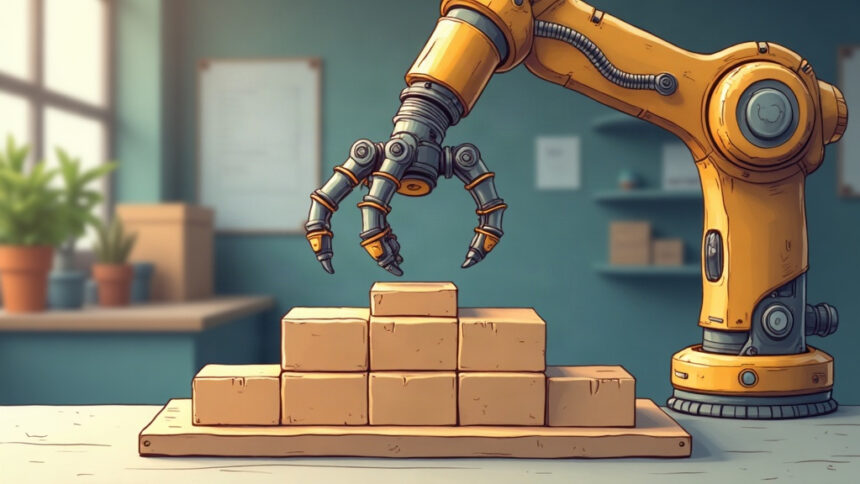
A robot hand that only sees is guessing about weight. Eka Robotics has built one that feels, and investors just handed it $150M to scale the idea.

Contents
Faster than a human baselineThe open question

The Cambridge, Massachusetts startup raised a Series A at a reported $1.45B valuation, led by Andreessen Horowitz and F-Prime, a Fidelity Investments affiliate. Obvious Ventures and E14 Fund, which co-led a $11M seed in May 2025, returned. Total funding now sits near $161M.

Eka calls its approach a vision-force-action model. Force sensors inside a custom gripper report how firmly an object is held, so the system can adjust mid-task when something starts to slide, rather than failing and retrying.

Faster than a human baseline

The company says its robots now pick unfamiliar objects at roughly 1,500 operations per hour, against a human benchmark of about 600. Grippers handle items up to one kilogram with a success rate above 95%, cost under $1,000 each, and are rated for 5 million duty cycles, short of the 20 million typical industrial arms sustain.

Pilots are running with unnamed industrial customers on pick-and-place and wire handling, the sort of dull, repetitive work packing strawberries or assembling server racks for GPUs.

The open question

Kris Hauser, a professor at the University of Illinois Urbana-Champaign, told TechCrunch the demo carried real wow factor because the robot adapted across many objects without retraining. He also asked whether the system survives a year on an assembly line without failing, and whether it generalizes past picking and placing.

That is the right question. Manipulation demos have impressed for a decade; factory floors are less forgiving. Eka’s founders, Pulkit Agrawal of MIT’s Improbable AI Lab and Tuomas Haarnoja from Google DeepMind, are betting on force data being the difference.


Trustly trims a quarter of its staff in open banking reset
Opsin lands $21M to watch over staff AI agents
Battery storage firm Octave.energy banks €10M for Europe push
Tesla alumni bank $12.5M to let AI run supply chains
Atoms preps robotaxi push after holding talks with Uber
TAGGED:Andreessen HorowitzdexterityEka Roboticsfunding roundsphysical AIrobot manipulation
SOURCES:SiliconANGLE
Share This Article
Facebook Copy Link Print
Previous Article Ex-OpenAI research chief opens Arda with $232M for factory lines
Next Article Legora leaps to $8.8B as corporate legal teams sign on

Get Some Gear


Quick Links

  • News
  • Features
  • Spotlight
  • Newsletter
  • Store

About Techflier

  • About Techflier
  • Services
  • Contact Us
  • Privacy
  • Legal

Indices

TechflierTechflier
Follow US
© 2026 Techflier. All Rights Reserved.
Welcome Back!

Sign in to your account

Username or Email Address
Password

Lost your password?