
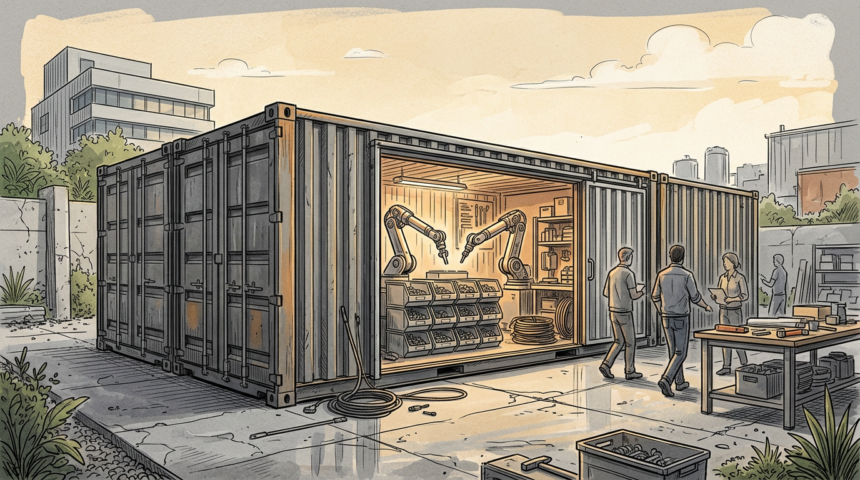
Backed by EUR 576K from 22 angel investors, Stockholm’s 120ft Factory began operating on Wednesday. The company turns out compact factories built to sit within three 40-foot shipping containers; their combined length is where the name comes from.
No customer ever buys a robot. Payment is per finished product, and brands retain their own parts suppliers, which deliver components to a 120ft site where machines pooled across multiple customers carry out final assembly, inspection, and packing.
Makers of small appliances and consumer electronics, design-led firms in particular, form the initial customer base. These companies frequently commit to production long before they know what will sell. Founder Martin Willers calls the resulting journey of components, out to China for assembly and back to Europe, a geopolitical exposure and not simply a logistics bill.
Designs, bills of materials, and quality requirements go into a software layer that translates them into digital instructions. Every job is simulated before a line starts, surfacing gaps and bottlenecks early, and an orchestration layer determines the response when a task fails.
The company has demonstrated a complete lamp build. Robots seated a cylinder lock, threaded a bulb fitting, and ran a functional test. In 2025 teaching one assembly skill consumed seven weeks; the figure is now seven hours, with a 2027 target of seven minutes.