Ask operators of AI data centers what hurts most and the answer increasingly is not silicon supply but the electricity bill. Seoul-based FuriosaAI has just raised $620M on that thesis, valuing the nine-year-old startup at $2.9B.
South Korea’s National Growth Fund supplied $280M of the round, part of a state push behind domestic chipmaking. Cisco Investments, Abu Dhabi’s NeoFort Holdings, QUDA Capital Partners, Jericho Capital and Worldline Capital added $110M, with Korea Development Bank, Kakao Investment and NAVER filling out the rest.
Tensor contraction instead of matrices
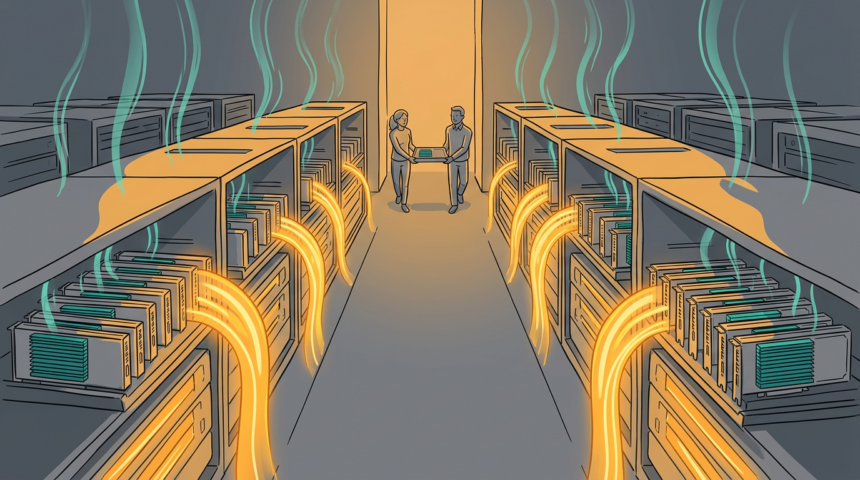
FuriosaAI’s RNGD chip and its Tensor Contraction Processor architecture treat tensor contraction as the core unit of computation rather than the rigid two-dimensional matrix math Nvidia’s GPUs rely on. Deterministic execution on the silicon keeps data movement – the biggest power drain in inference – to a minimum. The company claims less than half the power draw of Nvidia hardware while staying compatible with PyTorch and vLLM.
Korean buyers have already bitten. LG Group runs its EXAONE models on the chips, Upstage uses them for live search summaries, and Samsung SDS sells access through its neural processing units-as-a-service offering.
Production volumes and a Broadcom sequel
Chief executive June Paik says the capital moves the company into a new phase, with $620M earmarked to scale manufacturing. FuriosaAI plans to ship 20,000 next-generation chips this year and 40,000 in 2027, and is co-developing a third-generation processor with Broadcom.
NAVER Ventures partner Yong Jung Park, an investor since the pre-seed in 2017, argues the startup has cleared the hurdle that kills most chip companies by turning architecture into commercial hardware that customers deploy.