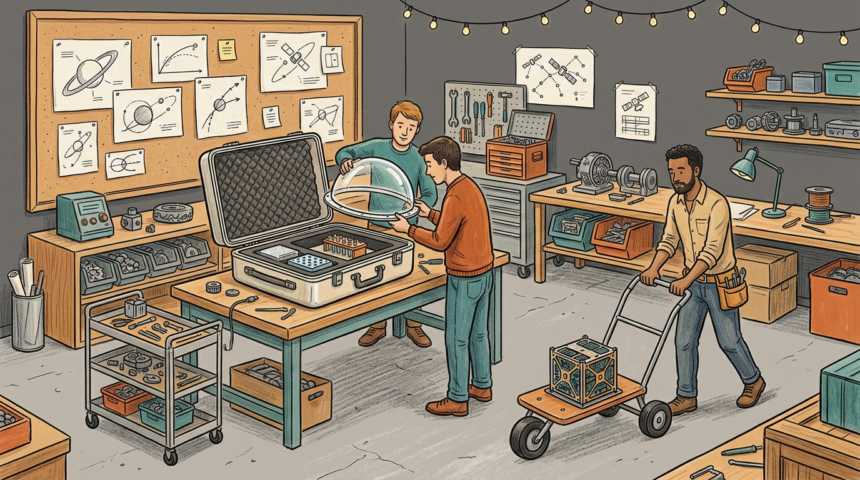
Most pharmaceutical and biotech teams would happily run experiments in weightlessness. Almost none want to become satellite operators to do it. Tumbleweed’s pitch is a laboratory that arrives in a box, flies itself and reports back like a rented server.
A record Austrian seed
The Vienna and Delft company raised €6.9M led by PactVC, with Vanagon Ventures, Prototype Capital and EWOR joining. It is the largest spacetech seed Austria has produced, and it lands four months after Oasis Alpha, the country’s first commercial satellite, rode a SpaceX Transporter mission into orbit in July carrying experiments for four customers who had never flown anything before.
The bottleneck is paperwork, not rocketry
Chief executive Julian Rothenbuchner argues the hard part of microgravity research is not the launch. It is payload preparation, safety certification and orbital operations, which can add years before an experiment leaves the ground. Tumbleweed’s pre-certified pods supply power and data connectivity, so customers install their own equipment, test it at home, then hand the container over. In orbit each pod runs remotely, and customers have completed work for low- to mid-five-figure sums.
From a school science project to a company
Rothenbuchner started building drones at eight and, at sixteen, sketched a wind-driven Mars rover inspired by the plant that gave the company its name. The concept won a European Space Agency grant and grew into a volunteer research network before he concluded academia moved too slowly. More than a third of the 25-person team has put its own money into the rounds.
The next step is repeat missions and higher throughput, with Austrian innovation minister Peter Hanke citing the company as evidence of domestic competitiveness in future technologies.