
ArXiv, the venerable preprint server that has served as the primary distribution channel for cutting-edge research in computer science, mathematics, and physics for over three decades, just drew a line in the sand. And for startup founders building on the bleeding edge of AI research, that line matters more than you might think.
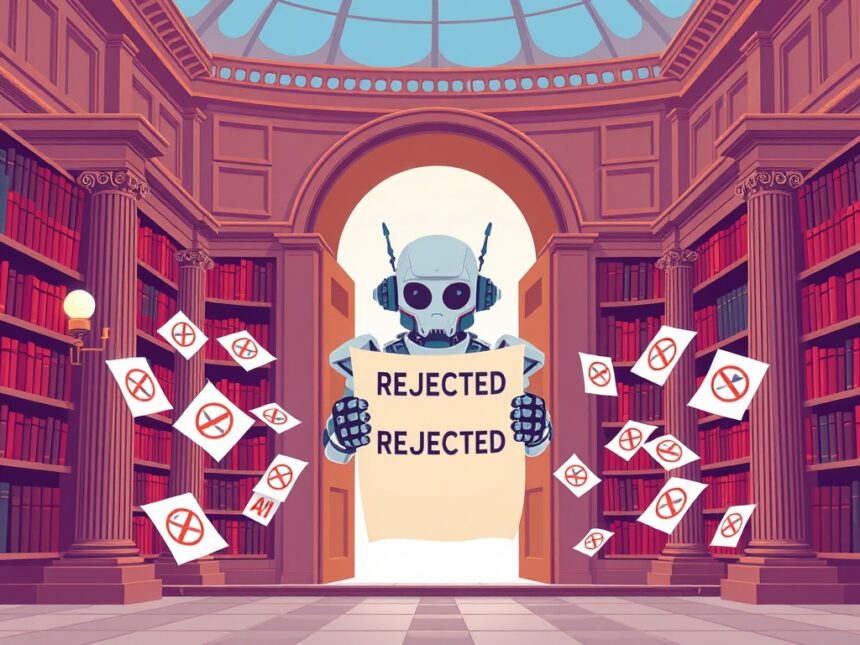
The new policy is strikingly direct: if a submission contains “incontrovertible evidence” that authors did not bother to check what their LLM generated — hallucinated citations, leftover “as an AI” commentary, or placeholder text that was clearly never meant to see the light of day — the authors face a one-year ban from the platform. After that ban, any subsequent submission must first be accepted by a reputable peer-reviewed venue before it can appear on ArXiv.
This is not a ban on using AI tools. It is a ban on outsourcing your scientific integrity.
Thomas Dietterich, chair of ArXiv’s computer science section, laid it out plainly: if a paper contains evidence that the authors failed to check LLM output, “this means we can’t trust anything in the paper.” It is a difficult position to argue against.
Why This Matters Beyond Academia
For the startup world, ArXiv is not merely a library — it is infrastructure. Companies building AI models, robotics systems, biotech platforms, and quantum algorithms all consume research from ArXiv daily. When the quality of that research degrades, the entire ecosystem suffers. A hallucinated citation in a paper today becomes a flawed assumption in a product roadmap tomorrow.
The timing of this policy is revealing. Recent research published in The Lancet found that fabricated citations are climbing in biomedical literature, almost certainly driven by LLM misuse. Studies tracking AI-generated content in computer science conferences show a marked uptick in papers that read like they were produced by a language model running on autopilot. The signal-to-noise ratio is dropping, and that is a real problem for anyone whose R&D depends on separating genuine breakthroughs from AI-generated fluff.
ArXiv’s move follows other steps designed to preserve trust. The platform now requires first-time submitters to obtain an endorsement from an established author, and it is spinning off from Cornell University into an independent nonprofit with a mandate to raise more money specifically to combat AI slop. These are the actions of an organization that recognizes its role as a gatekeeper — and takes that responsibility seriously.
A Warning for Startups Building on Research
If you are a founder building a deep tech startup, here is what you need to internalize: the cost of bad research is no longer theoretical. Your engineering team reads ArXiv papers to decide what architectures to try, what benchmarks to target, and what methods to adopt. Every hallucinated citation or unverified result that slips through is potential waste — wasted engineering hours, wasted compute, and wasted runway.
The sharpest founders we follow are already building verification pipelines into their research consumption. They do not take ArXiv papers at face value. They run the experiments themselves or wait for peer-reviewed validation before committing serious engineering resources. ArXiv’s new policy should accelerate that trend, making it clear that the platform itself recognizes the problem and is taking steps to address it.
The Bigger Lesson for AI-Native Products
There is also a broader message here for any startup shipping AI-generated content. ArXiv is effectively saying: you may use AI tools, but you — the human author — remain fully responsible for what you publish. That exact principle applies to every startup building AI features into their product.
Whether you are generating code, marketing copy, medical advice, or legal analysis, your customers and regulators will hold you accountable for the output, not the tool. The companies that internalize this early — those building validation loops, human review systems, and quality gates into their AI pipelines — will have a durable competitive advantage. The ones that treat LLMs as a “set it and forget it” solution are one high-profile hallucination away from a crisis of trust.
The Takeaway for Founders
Founders should watch ArXiv’s experiment closely because it is a leading indicator. If a preprint server with limited resources can enforce quality standards around AI-generated content, regulators and enterprise buyers will not be far behind. The era of blaming bad output on “the AI” is ending. The question is no longer whether your startup uses AI — it is whether you take responsibility for what it produces.
This story was based on reporting by Anthony Ha at TechCrunch and Jay Peters at The Verge.