
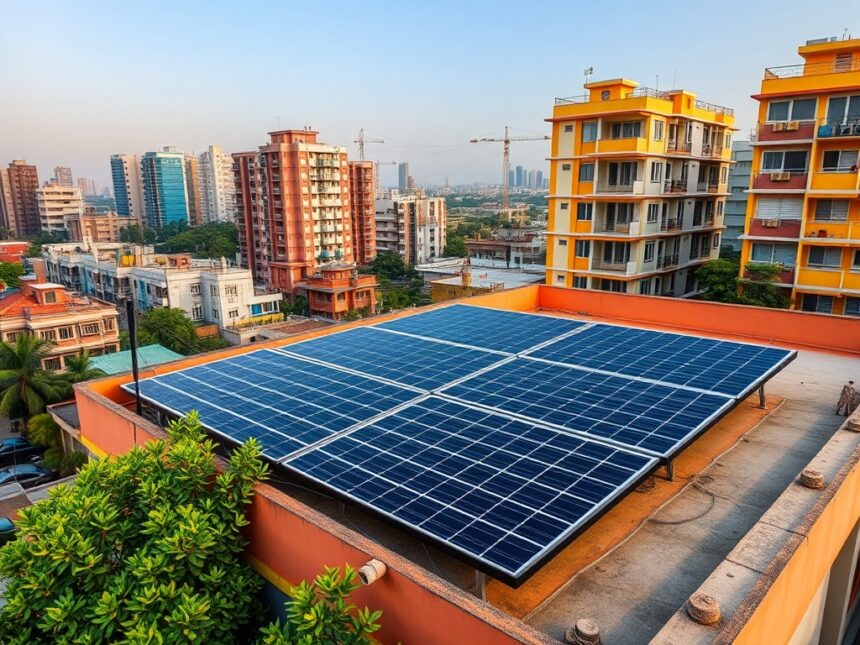
Two of the most prominent venture firms betting on India’s next wave of tech giants are putting significant capital behind something decidedly low-tech in appearance: solar panels on residential rooftops. B Capital and Lightspeed Venture Partners are co-leading a Series C round in SolarSquare that could reach $60 million, valuing the Mumbai-based startup between $450 million and $500 million — more than double its valuation from just 18 months ago.
The round, expected to close next month, signals a fundamental shift in how venture investors view India’s energy transition. SolarSquare had already secured what was India’s largest solar venture round in December 2024 with a $40 million Series B at roughly a $200 million valuation. This time, Lightspeed is investing through its growth fund — the same vehicle that backed Razorpay and Zepto — while existing investor Elevation Capital is also participating.
<2>Why rooftop solar is suddenly big venture business
India’s renewable energy ambitions are staggering. The country has set a target of 500 gigawatts of renewable capacity by 2030, with solar expected to deliver more than half. Cumulative installed solar capacity has exploded from about 3 GW in 2014 to more than 150 GW in 2026, making India the world’s third-largest solar power producer behind only China and the United States.
But the residential rooftop segment has long been the laggard. Unlike utility-scale solar farms that attract institutional infrastructure capital, residential solar in India has been a fragmented market dominated by small local installers and dealer networks tied to component manufacturers like Tata Power, Waaree Energies, and Luminous Power Technologies. That fragmentation is exactly what VCs see as an opportunity.
<2>Full-stack play in a fragmented market
Founded in 2015, SolarSquare operates as a full-stack residential solar platform — handling design, installation, and maintenance for homes, housing societies, and enterprises. The company has installed more than 150 megawatts of solar capacity across 29 cities in nine states, powering nearly 50,000 homes and around 400 housing societies (the gated apartment communities common across urban India).
Notably, residential customers and housing societies now account for the majority of SolarSquare’s business, as the startup has deliberately scaled back lower-margin industrial projects. The bet is that India’s urban middle class, increasingly conscious of both electricity costs and environmental impact, represents a massive addressable market that traditional solar installers have failed to serve well.
The financials back up the thesis. SolarSquare has crossed an annualized revenue run rate of more than ₹10 billion — roughly $104 million — across its residential and housing society segments alone. The company aims to reach 200 megawatts in its residential solar portfolio this year.
<2>The enterprise tilt that signals confidence
Beyond homes, SolarSquare has deployed rooftop systems for major Indian companies including Swiggy, Zepto, and iD Fresh Food. That enterprise validation matters: when logistics and food delivery companies put solar on their facilities, it’s a sign that the economics work at scale — not just for subsidized early adopters.
The broader context is that India’s startup ecosystem is producing an increasingly diverse set of winners. While Indian venture capital has historically concentrated in SaaS, fintech, and e-commerce, energy infrastructure startups are emerging as a new category. SolarSquare has raised $61.1 million in equity to date, a figure that will more than double with this round.
<2>The takeaway for founders
SolarSquare’s trajectory offers a clear lesson: the biggest venture returns in the coming decade may come from industries that don’t look like traditional tech. India’s infrastructure gaps — in energy, logistics, housing, and manufacturing — create opportunities for startups that can combine technology with real-world operations at scale.
The fragmentation that makes residential solar a headache for consumers is precisely what makes it a venture-scale opportunity. A startup willing to build a full-stack solution in a messy, physical-world market can capture margin across the value chain while competitors fight over thin slices. That playbook has worked in everything from food delivery to digital payments in India. SolarSquare suggests it works for energy too.
Original reporting by Jagmeet Singh for TechCrunch.