
Every time you fire up ChatGPT, run a text-to-image generator, or use a coding assistant, an invisible data traffic jam occurs inside the server infrastructure running that query. Data has to move from memory, through a CPU, over to a GPU for the heavy lifting, and back again — repeating that cycle for every single token the model produces. The industry has spent billions optimizing GPUs and CPUs, but the transport between them has remained stubbornly inefficient.
That inefficiency is the open secret of AI infrastructure. And a four-year-old startup with roots in South Korea’s semiconductor powerhouse ecosystem believes it has found the fix.
XCENA, co-founded in 2022 by Samsung and SK Hynix veterans, has raised $135 million in Series B funding at a $570 million valuation to commercialize a chip design that rethinks one of the most fundamental assumptions in modern computing: that data should travel to the processor.
The startup’s thesis is contrarian but compelling. While the AI world obsesses over training flops and who has the fastest GPU, XCENA argues that the real bottleneck is memory bandwidth and latency. “CPUs and GPUs have both gotten smarter over the decades. Memory never did,” CEO Jin Kim told TechCrunch. “The recent rise in memory prices and related stocks points to a broader shift in AI infrastructure toward memory-centric architectures.”
<2>Bringing compute to the data
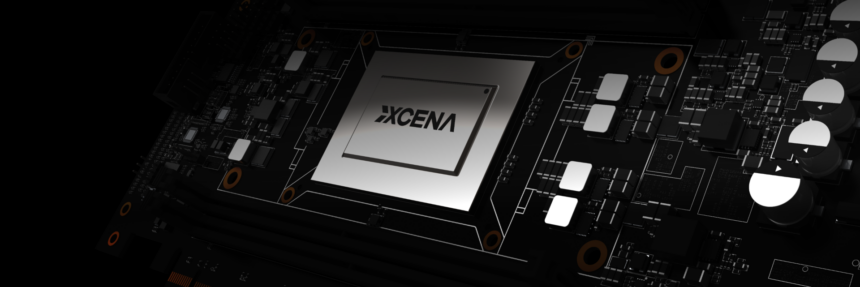
XCENA’s chip, the MX1, attaches to standard DRAM modules via CXL (Compute Express Link) — a high-speed interconnect standard that creates a dedicated express lane between processors and memory. Instead of shuttling data back and forth to a CPU or GPU for every routine operation, the MX1 processes data where it sits. The company claims the approach could reduce server requirements by an order of magnitude: what previously needed 10 servers might now fit on one.
The specific workloads XCENA targets include KV cache management (the memory system that stores conversation history so AI models don’t have to reprocess past exchanges), data preprocessing, and caching — all the orchestration tasks that surround the heavy matrix math that GPUs handle. These are not glamorous problems, but they account for a massive share of AI inference costs in production environments.
<2>The timing bet
XCENA’s timing looks fortuitous. This month, Samsung, SK Hynix, and Micron — the three global memory chip giants — each crossed trillion-dollar valuations for the first time, driven by demand for high-bandwidth memory (HBM) used in AI training. The macroeconomic winds are blowing in the startup’s direction.
Its ideal customers are hyperscalers — the Amazon, Google, and Microsoft tier of AI infrastructure spenders — where even marginal memory efficiency gains translate into hundreds of millions of dollars in savings. The MX1 is still in prototype, with mass production planned on Samsung’s foundry lines by the end of 2026, targeting revenue by 2027.
Competition includes publicly traded players like Astera Labs and Marvell, both working on next-gen memory connectivity. But Kim argues XCENA’s differentiation is architectural: “We have thousands of cores,” he said, noting that the company builds its own internal memory hierarchy, interconnect bus, and DRAM controller in-house — a depth of vertical integration most chip firms outsource.
<2>What this means for startup founders
XCENA’s story offers a broader lesson for founders building in the AI infrastructure space. The industry’s attention is overwhelmingly focused on who can build the fastest training chip or the most efficient model architecture. But real-world AI deployment is a systems problem, not a component problem. The bottlenecks in production often live in places nobody is looking — in data movement, memory latency, and the orchestration layers between specialized processors.
Some of the most valuable companies in the next wave of AI infrastructure won’t be the ones building faster GPUs. They’ll be the ones solving the dull-sounding logistics of how all these components talk to each other. XCENA’s $570 million valuation at Series B — still relatively early for a semiconductor company — suggests investors are beginning to bet on that thesis in a serious way.
For founders, the takeaway is clear: look for problems that are critical but invisible. Every hyperscaler knows memory access is a gnarly bottleneck. But most are too busy training the next big model to rewire the memory layer from scratch. That’s exactly the kind of gap a well-funded startup can fill.
—
This article was adapted from reporting by Kate Park at TechCrunch. Read the original story here.