
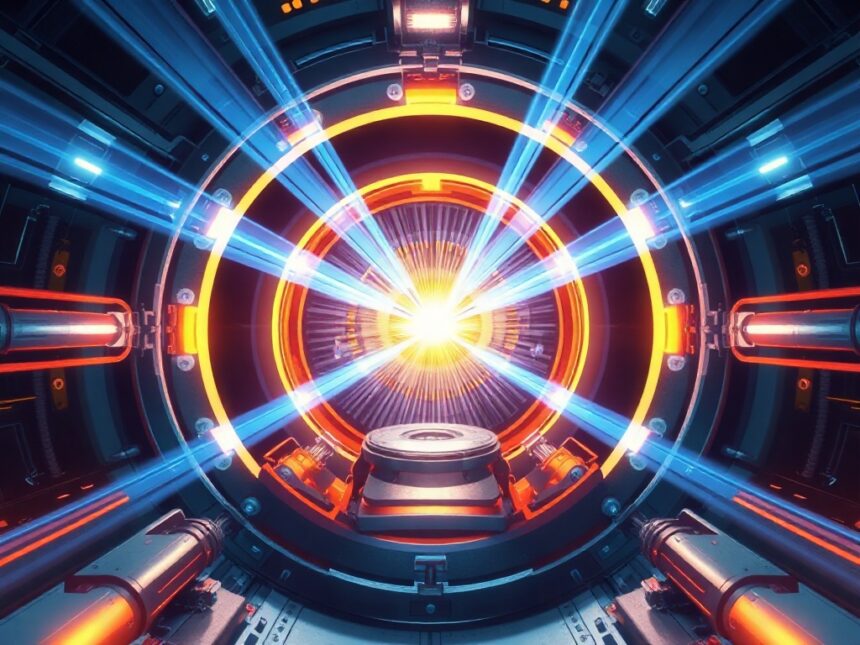
Fusion energy has long been the holy grail of clean power — limitless, carbon-free, and safe. For decades it was always “30 years away.” But 2026 is shaping up to be the year that timeline finally starts to collapse, and one startup just made the biggest bet yet.
<2>A $240m bet on laser-powered fusion
Germany-based Focused Energy has raised a whopping $240 million Series A round, one of the largest early-stage rounds ever for a fusion startup. The round was oversubscribed, bringing the company’s total private capital to $300 million, with an additional $200 million in government grants. That makes Focused Energy one of the most heavily capitalized fusion startups in the world.
The company’s approach? Inertial confinement fusion — essentially, firing powerful lasers at a tiny fuel pellet to compress it so violently that atoms fuse and release massive energy. Think of it as creating a miniature star, over and over, in a controlled setting.
It’s the same science behind the groundbreaking National Ignition Facility (NIF) experiment at Lawrence Livermore National Laboratory, which in 2022 became the first and only experiment to achieve a net positive energy gain from controlled fusion. Focused Energy is essentially trying to commercialize that breakthrough.
<2>From 400 shots per year to 864,000 per day
Here’s where the engineering challenge gets real. NIF fires its lasers about 400 times per year. Focused Energy needs to fire 10 shots per second — that’s roughly 864,000 shots every single day.
To get there, the company is taking a radically simpler approach than NIF. The lab’s setup uses a precision-manufactured gold cylinder called a hohlraum to convert laser energy into X-rays, which then compress the fuel. Focused Energy is going “direct drive” — its lasers hit the fuel pellet directly, cutting out the middleman entirely. That simplicity boost is crucial for both efficiency and the ability to mass-produce the reaction.
Debbie Callahan, who helped design NIF’s fuel target and joined Focused Energy as chief strategy officer in December, is working to simplify the target design further. A simpler target means easier manufacturing, which is essential when you need to produce them at industrial scale.
<2>Building the lighthouse
Focused Energy plans to build its first demonstration system, called Lighthouse, at the site of a decommissioned nuclear fission plant in Germany. The irony isn’t lost on anyone — replacing an old fission plant with a next-generation fusion demo on the same site is a powerful symbol of the energy transition.
The site is owned by RWE, the German utility that also led this Series A round. Other investors include the German Federal Agency for Breakthrough Innovation (SPRIND), Prime Movers Lab, and the European Innovation Council Fund.
<2>What this means for startup founders
Focused Energy’s massive raise is a signal for anyone building in deep tech. Here’s what founders should take away:
Government support matters more than ever. Focused Energy has $200 million in grants alongside its private funding. European and US government programs are actively looking for deep tech bets — don’t ignore non-dilutive funding.
Borrow from proven science, then simplify. Focused Energy didn’t invent fusion from scratch. It took the NIF’s proven approach and is engineering the hell out of the simplification problem. The most successful deep tech startups often commercialize existing scientific breakthroughs rather than chasing fundamental discovery.
Location advantages are real. Building on a decommissioned plant site gives Focused Energy existing grid connections, regulatory familiarity, and community acceptance. Think about what existing infrastructure your startup can repurpose.
<2>Fusion’s moment
Focused Energy isn’t alone. The fusion funding spree this year has been remarkable: Inertia Enterprises raised a $450 million Series A in February, Thea Energy raised $100 million just last week, and Type One Energy is closing in on a $250 million Series B. Investors are betting that at least one of these approaches will crack the code to commercial fusion.
The prize is worth it. A successful commercial fusion reactor would provide virtually unlimited clean energy with no carbon emissions, no meltdown risk, and minimal waste. For startups building the future of energy, the message is clear: the window is opening, and the capital is flowing.
Source: TechCrunch