
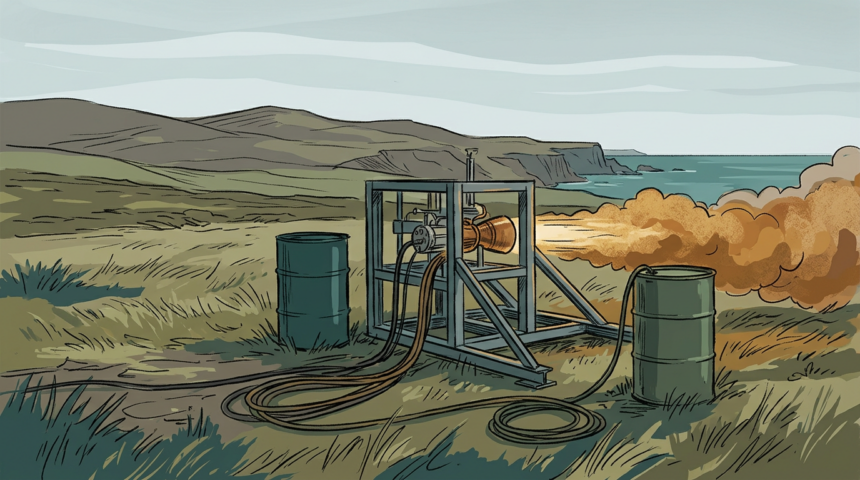
A coastal test site in Scotland hosted a full engine burn this week as Skyrora put a smaller stand-in for its orbital rocket through a 45-second static hot-fire run. The vehicle is a scaled-down version of Skyrora XL, the UK company’s planned orbital launcher.
Engineers built the smaller article to exercise subsystems and components close to those bound for the full-size rocket. It logged data on the pressurisation system and core engine behavior, including propellant flow rate and chamber pressure. Early readings point to a clean run, and the team is now working through the results before a second firing.
The philosophy behind the program is deliberate repetition: run hardware early, run it often, and prove components in combination rather than in isolation. Testing at reduced scale lets engineers surface problems while fixes are still cheap, lowering the technical risk that builds up before full-scale integration.
Chief operating officer Dr Jack James Marlow argues that confidence in an orbital vehicle is built through thousands of decisions and measurements rather than a single launchpad moment, and that the scaled-down system lets the team validate technology and components as one unit.
The milestone lands as Europe’s launch sector tries to close the gap with the US and China. A crowded field of small-rocket startups is chasing a narrow window of demand, making repeatable, low-cost testing a key differentiator for teams that cannot afford failures late in development.