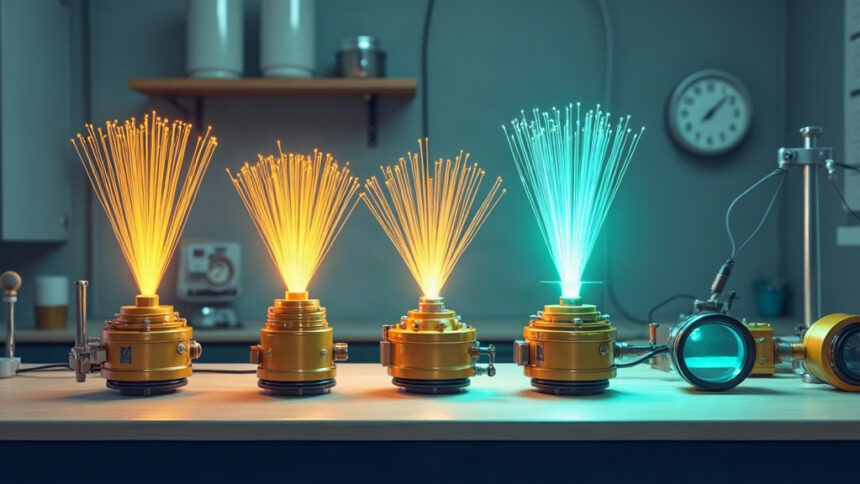
The lights that join AI processors together are about to become harder to buy than the chips themselves. Photon Bridge, based in Eindhoven, raised EUR 10M to manufacture them at a volume the industry has never needed before.
New money came from the Amadeus APEX Technology Fund and 360 Capital, which shared the lead, and three earlier holders, Innovation Industries, Faber and Brabant Development Agency, wrote larger checks.
Demand arrives with 800G and co-packaged optics
Omdia expects shipments of more than 20 million AI accelerators for data centers to clear that mark each year by 2028. Clusters have gone from thousands of processors to hundreds of thousands, and shuffling data among them now limits what a system can do. Light carries far more than copper over distance, which is why optics keeps creeping toward the die itself.
Those lasers were never mass-produced at this scale. The high-power parts available today grew out of telecom and subsea builds, where yearly output is modest, and AI turns the laser into a component that must come off semiconductor lines by the million.
Photon Bridge chose to sidestep brute force. Instead of demanding a few ever-more-powerful devices, it mixes light from a large number of lower-power semiconductor lasers. Running cooler per device means small fabrication flaws matter less, so yield holds up as output grows.
Its design delivers high wavelength counts and as much as 40 mW per wavelength per fibre, and can be built at multiple indium phosphide foundries. Paul Marchal, the chief executive, contends that each computing era pushes the hard problem further down the supply chain; lasers are the current one. First samples are due in 2027, with volume production set for 2028.