
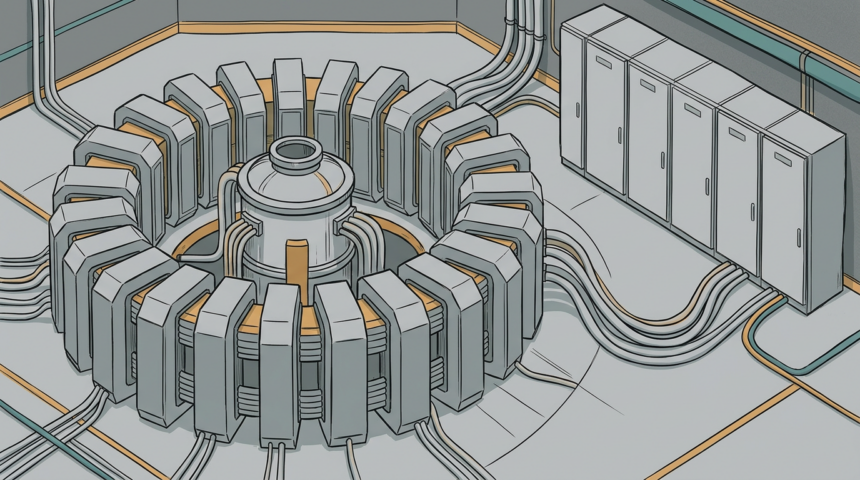
The fusion industry spent a decade arguing about whether it can build a reactor. The next question is a supply chain. Commonwealth Fusion Systems took an $85M CHIPS Act award from the Commerce Department this week to answer it, money that also grants Washington a stake.
CFS aims to switch on its Sparc demonstration reactor next year. One working machine is a proof point; dozens of plants would need power electronics that do not yet exist at the required durability, which is the gap here.
Silicon carbide first
The largest slice goes to silicon carbide power electronics. Those chips already manage high voltages in EVs and data centres, and inside a fusion machine they drive the superconducting magnets that confine plasma. Better devices lose less energy between grid and coil.
It will also build next-generation radio-frequency generators that heat the fuel, plus control electronics hardened against radiation – quietly important, since gear that survives inside a plant extends replacement cycles across a multi-decade life.
Part of it adapts AI hardware such as GPUs and TPUs for plant control, a crossover reflecting how much modern fusion design depends on real-time plasma modelling rather than mechanical engineering.
The government as shareholder
Brandon Sorbom, co-founder and chief science officer, framed the result as a more capable, economical plant plus a stronger domestic supply chain. The equity is the more interesting detail: it makes Washington a financial participant in a private fusion company’s success.
For the sector the signal outweighs the sum. Fusion startups raised private capital on the promise of commercial plants; an award tied to manufacturing suggests the state expects those plants built with American parts – and will fund the tooling before the first order.