
Industrial inspection hits a hard physical limit. A few centimeters of steel stop an X-ray cold, and much of what modern industry builds is thicker. MuRay, a Hamburg startup from Dr Andi Hektor and Dr Kristjan Poder, bets muons get through where X-rays cannot.
The deeptech company has banked 7.1 million euros. First Momentum Ventures led a 3.5 million euro private slice, with Caelora, a wholly owned Marvel Fusion subsidiary, co-leading. Nordic Science Investments, an existing holder, was joined by Match VC, Superangel, Tiny VC and Arcas VC. Another 3.6 million euros arrived as non-dilutive public money, including a Horizon Europe grant. Hektor and Poder are co-CEOs.
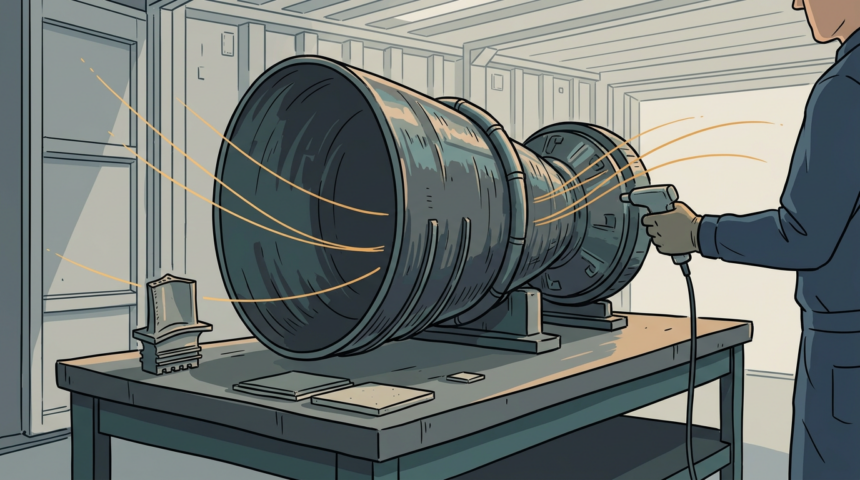
Muons cross dense matter that blocks conventional radiation, letting the system build high-resolution 3D pictures of metal, ceramic and composite parts. It can tell density and composition apart, and per the company, scans finish in minutes rather than hours at a markedly lower radiation dose than an X-ray rig. Hektor notes that the sector, from reusable rockets to gas turbines, uses metal well past where X-ray penetration gives out.
The opening market is quality assurance on safety-critical parts like 3D-printed rocket engines and gas turbine components, where hidden internal flaws keep hardware grounded. Poder says undetectable defects leave parts idle longer than schedules allow. Working alongside the German Space Agency at DLR, the company modeled an engine scan and expects to test the approach for real in 2027. Space, aerospace, defense and energy work could follow, cutting maintenance cycles on reusable rocket and jet engines.
The cash funds commercialization built around hardware that travels: a shipping-container-sized mobile imager for on-site inspection. MuRay plans its first industrial imaging service in 2027, pairing DESY’s Hamburg electron beam with its own system, then a full-scale laser-driven accelerator unit in 2029.