
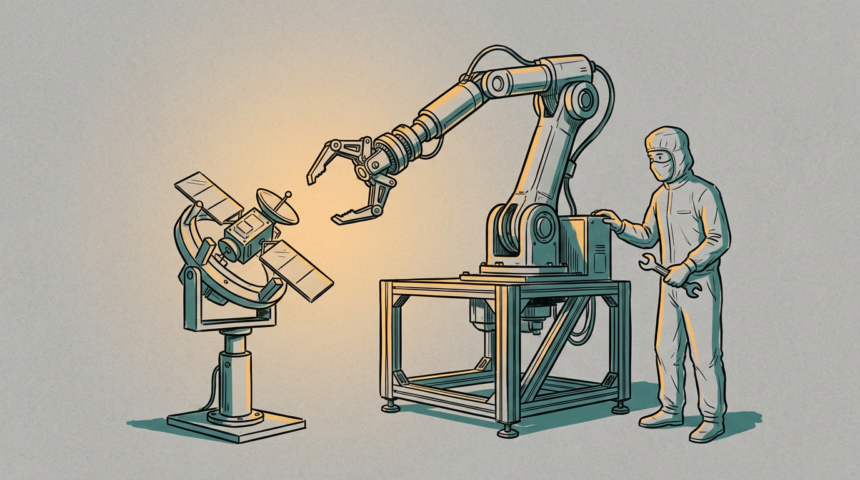
Seed money of $6M is in the bank at Cosmoserve Space, which also cut the ribbon on Base 1, a Hyderabad site for testing robots meant to seize dead satellites and haul them out of orbit.
Rebright Partners of Japan wrote the lead cheque. Fresh capital came from Aranya Holdings and Naandi Ventures. AUM Ventures and Shakti VC, already inside, put in more. Against the $3.17M pre-seed of September 2025, the new cheque is close to double.
Why petals beat claws
A mechanical arm struggles with a tumbling hunk of metal, so Cosmoserve went soft. Flexible petals close around awkward shapes, steered by camera-based navigation.
Two machines split the work under its Dual Spacecraft Architecture. One is an Orbital Service Station, parked as a depot of fuel, spares and equipment. The Autonomous Service Vehicle heads for a target satellite, grapples it, docks, diagnoses faults, mends what it can or drags it clear.
Base 1 fills about 14,800 square feet at VSD Tech Park in Gachibowli. Only five sites worldwide pair microgravity simulation with space vision effects, Cosmoserve says, and this is both the sixth and the first in private Indian hands. Engineers rehearse grabs there before launch.
Toward a 2027 capture
Chiranjeevi Phanindra spent almost 15 years at ISRO on Gaganyaan and sat on the Inter-Agency Space Debris Coordination Committee for India, then founded the firm in June 2025.
Microgravity flights are next, then Embrace-2, a repeat of the Embrace mission with a reworked mechanism. The headline goal is a full-scale capture in 2027 that closes to within 10 metres of a defunct satellite. Paid service is the mid-2028 target.
Letters of intent have arrived from operators in America, Europe and India, the company says. Nobody has yet shown that clearing orbit pays for itself.