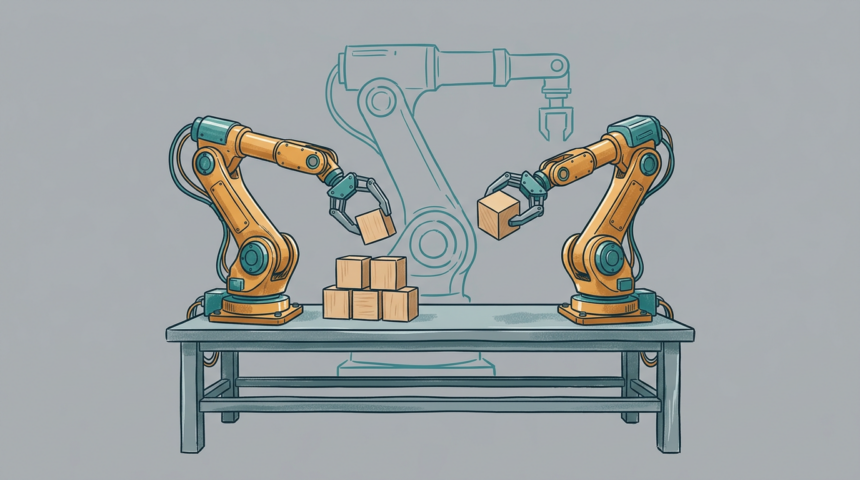
Robots that can do exactly one job are cheap now. Teaching them a second job is where the money goes, and Brazil’s Dream Labs thinks video is the shortcut.
The startup came out of stealth on Monday with Dream-1, a foundation model it calls a universal brain for two-armed machines, plus an open API. Seed funding of $90M arrived jointly led by B Capital and Kindred Ventures, joined by A.Capital, Unusual Ventures, Wing VC, SV Angel, Scribble VC and angel investor Adrian Aoun.
Dream Labs’ premise is simple arithmetic. Roughly 5 million industrial robots work in factories and warehouses worldwide, nearly all designed for a single task, with no way to hand their knowledge to a different machine. Meanwhile the hardware itself has collapsed in price, with dexterous arms now selling for a few thousand dollars.
So the bottleneck is software and training time. Programming a new arm for a new job generally takes months of specialist work, and the process resets whenever hardware changes. Dream-1 instead treats robotic skill as a video prediction problem, learning from footage of people stacking shelves or packing boxes, then inferring the physical move required to reproduce the outcome.
The company says the model controls bimanual robots with parallel grippers it has never seen, on tasks it was never trained for, from $3 per hour. Joel Jang, co-founder and chief executive, reaches for a rental-car comparison. A driver does not relearn driving in an unfamiliar vehicle, only where the controls sit.
That is a bet on generality over precision. Robots that absorb video feeds and plain instructions could reach useful work in minutes, but factories will demand reliability before routing production through one. Dream Labs is wagering that whoever owns the transferable skill layer owns the market.