Most critical infrastructure sites cannot afford the radar needed to spot a drone overhead. A Paris startup thinks the price is the problem to solve, not the technology.
Gallium Defense emerged from stealth with a €7.1M seed round led by Keen Venture Partners and 360 Capital, with Omnes Capital and Polytechnique Ventures participating. The announcement landed during European Defence Week in Paris.
Founded in April 2026 by Eric Fournier, Florian Lemoine and Robin Mandel, the team brings backgrounds from Boston Consulting Group, NATO advisory work, Thales and Safran. Fournier’s framing of the brief is blunt: meet 80% of the need at 20% of the price.
The company says more than 80% of critical infrastructure and military assets remain exposed to modern drone threats for lack of affordable, field-ready radar.
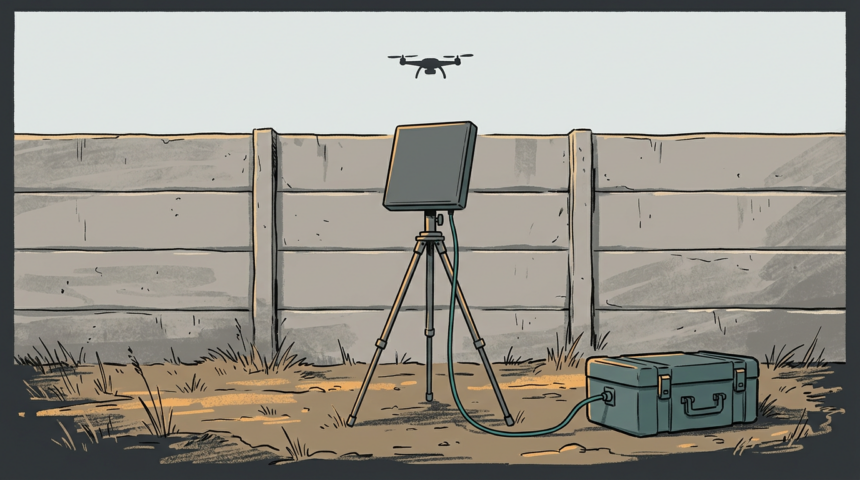
Its answer is the GDS-10, an X-band AESA radar with a software-defined, AI-native architecture built largely from commercial off-the-shelf components. It detects Class 1 and FPV drones at 10km with 360-degree azimuth and 90-degree elevation coverage, tracking multiple targets including swarms, day or night, in all weather.
Two versions exist, one for critical infrastructure operators and one for armed forces, and because the radar is software-defined its capabilities can evolve as threats change. Mandel’s pitch is volume manufacturing by design, hundreds of units rather than bespoke one-offs.
First open-air field trials took place just four months after the seed round closed. The funding industrialises production, trains the models and supports demonstrations for civil and military buyers, with orders for the GDS-10 planned to open in the first quarter of 2027.
The counter-drone market is crowded with jamming, nets and interceptors. Detection remains the unglamorous first step, and a cheaper sensor changes how many sites can afford to start.