
TechflierTechflierTechflier
  • Home
  • News
  • Features
  • Spotlight
  • About
    • Mission
    • Services
    • Contact
  • Newsletter
  • Shop
    • All Items
    • By Category
      • Bags
      • T-Shirts
    • Cart
Search
© 2025 Techflier. All Rights Reserved.
Reading: Path Robotics lands $300M as welding robots learn to adapt
Share
Font ResizerAa
TechflierTechflier
Font ResizerAa
  • Home
  • News
  • Features
  • Spotlight
  • About
  • Newsletter
  • Shop
Search
  • Home
  • News
  • Features
  • Spotlight
  • About
    • Mission
    • Services
    • Contact
  • Newsletter
  • Shop
    • All Items
    • By Category
    • Cart
Have an existing account? Sign In
Follow US
© 2025 Techflier. All Rights Reserved.
News

Path Robotics lands $300M as welding robots learn to adapt

Georgian led a $300M Series E for the Ohio company teaching robots to cope with metal that warps as it cools.

Techflier Staff
Last updated: November 11, 2026 8:52 pm
Techflier
Share
SHARE

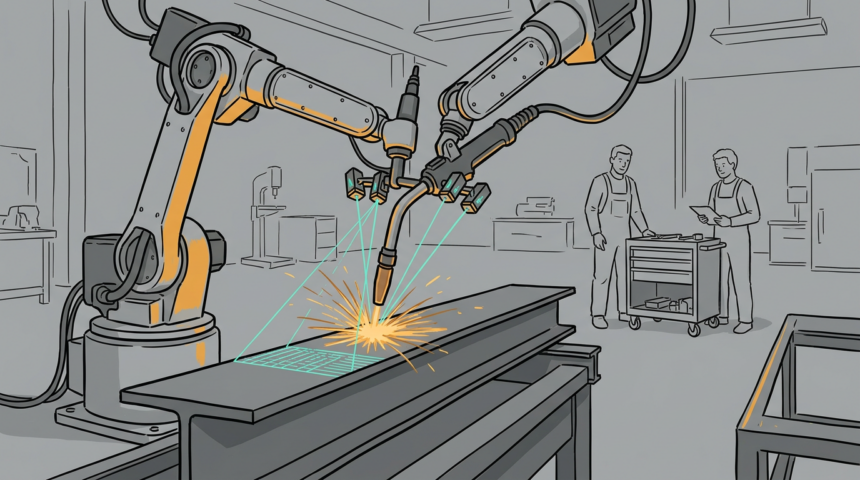
Automated welding keeps running into one stubborn physics problem. Heat warps the joint as the torch passes, and the part shifts again on cooldown, so a robot locked to a preprogrammed path aims at a target that has already moved.

Contents
A model that watches metal moveCapacity, not novelty, is the constraint

Path Robotics Inc. has raised $300M in a Series E at a $2.45B post-money valuation. Georgian led, with Yamaha Motor’s venture arm and Navier, a large South Korean tech company, among the participants. The Columbus, Ohio company announced the round Tuesday.

A model that watches metal move

Path’s answer is Obsidian, a model built for torch-equipped industrial robots. It reads how a part deforms mid-weld and reshapes the workflow in real time, absorbing the small differences between parts stamped from the same blueprint.

Four laser emitters mounted on the torch light up the seam, and two cameras capture the bounce-back. Path says Obsidian collects signal before, during and after every run, feeding a weld world model that researchers then use to generate simulated jobs and train the controller.

Obsidian began on large fixed welding cells. Rove, a four-legged platform the company showed off in April, carries the same software into shipbuilding. Vehicle components, generators and utility poles are further targets on Path’s list.

Capacity, not novelty, is the constraint

Chief executive Andy Lonsberry frames the raise around output, not replacement. Manufacturers need more production than conventional automation can supply, and many simply cannot add lines.

The money scales the welding business alongside customers and funds the data, compute and model work required to reach tasks upstream and downstream of the weld itself.

Physical AI is now one of the more heavily funded corners of industrial tech. The question investors are underwriting is whether a learned model holds tolerance in a shipyard the way it does in a demo cell.

Protein-testing lab Adaptyv banks €34M for agent-run experiments
VC groupthink is at an all-time high: What that means for startup founders
Andhra Pradesh and PanIIT plan a $52M deep tech fund
AI travel agency Fora hits unicorn status with $60M Series D
DeepMind co-founder Hassabis cedes helm to focus on AGI
TAGGED:industrial roboticsmanufacturingPath Roboticsphysical AISeries Ewelding automation
SOURCES:SiliconANGLE
Share This Article
Facebook Copy Link Print
Previous Article Dreeze wants to revive the whole app, not just the data

Get Some Gear


Quick Links

  • News
  • Features
  • Spotlight
  • Newsletter
  • Store

About Techflier

  • About Techflier
  • Services
  • Contact Us
  • Privacy
  • Legal

Indices

TechflierTechflier
Follow US
© 2026 Techflier. All Rights Reserved.
Welcome Back!

Sign in to your account

Username or Email Address
Password

Lost your password?