A hospital-grade eye scanner currently means a heavy tabletop machine and a months-long wait. Bristol’s Siloton wants the same scan from a chip smaller than a pound coin.
The University of Bristol spin-out won £8.4M from Innovate UK through its Contracts for Innovation: Quantum Missions Primer programme, delivered over two years. The money speeds up design and trials for the in-clinic and at-home versions of GiraffeOCT, its optical coherence tomography device, and the company thinks it could take two years off development.
Optical coherence tomography uses light to image the retina, catching conditions early and tracking them over time. Existing systems are large, costly and mostly confined to hospitals and optometry practices, which limits reach in rural areas. Ophthalmology is the busiest NHS outpatient specialty, with about nine million attendances in England in 2023/24 and nearly 623,000 people waiting at the end of July 2026, 8.7% of all NHS waits.
A chip the size of a coin
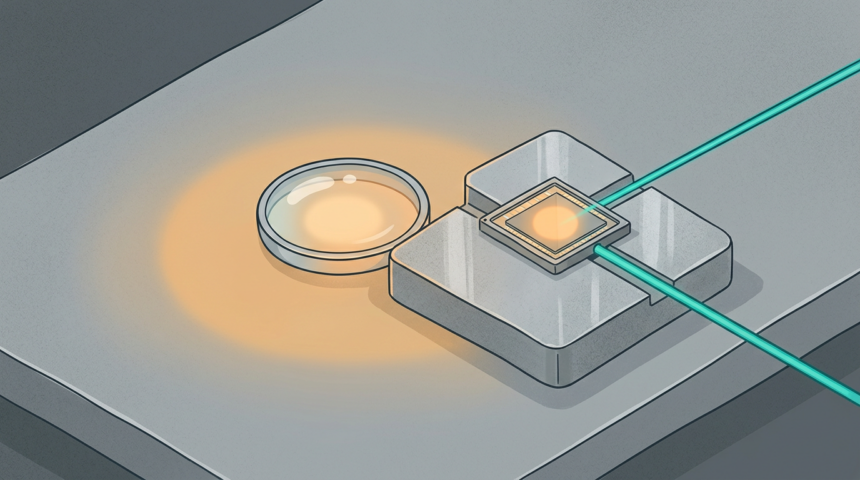
Siloton compresses a tabletop’s worth of fragile optics onto a single photonic chip. The GiraffeOCT is built as a binocular-style unit intended for clinics and eventually homes, with a second-generation BlueJay chip and a cloud platform behind the service.
Sunderland Specialist Eye Hospital will run clinical trials of the in-clinic device, and York Health Economics Consortium will sharpen NHS cost estimates from the data. Headcount is set to reach 16 by August 2028.
Chief executive Alasdair Price said the contract helps the company through the phase where deep-tech hardware usually stalls, and that fresh investment will follow to fund CheetahOCT, a device built to resolve separate retinal layers and widen the list of conditions it can spot. The European Space Agency, which needs to monitor astronaut vision, is already a customer.