
TechflierTechflierTechflier
  • Home
  • News
  • Features
  • Spotlight
  • About
    • Mission
    • Services
    • Contact
  • Newsletter
  • Shop
    • All Items
    • By Category
      • Bags
      • T-Shirts
    • Cart
Search
© 2025 Techflier. All Rights Reserved.
Reading: Dream launches with $17M to generate building blueprints
Share
Font ResizerAa
TechflierTechflier
Font ResizerAa
  • Home
  • News
  • Features
  • Spotlight
  • About
  • Newsletter
  • Shop
Search
  • Home
  • News
  • Features
  • Spotlight
  • About
    • Mission
    • Services
    • Contact
  • Newsletter
  • Shop
    • All Items
    • By Category
    • Cart
Have an existing account? Sign In
Follow US
© 2025 Techflier. All Rights Reserved.
News

Dream launches with $17M to generate building blueprints

Dream, a San Francisco startup founded by former Palantir executives, emerged from stealth with $17M led by Andreessen Horowitz.

Techflier Staff
Last updated: October 31, 2026 6:08 am
Techflier
Share
SHARE

Most AI startups promise to save knowledge workers an hour a day. Dream is taking legal responsibility for the output.

Contents
Blueprints, not a design toolThe hallucination problem is literal

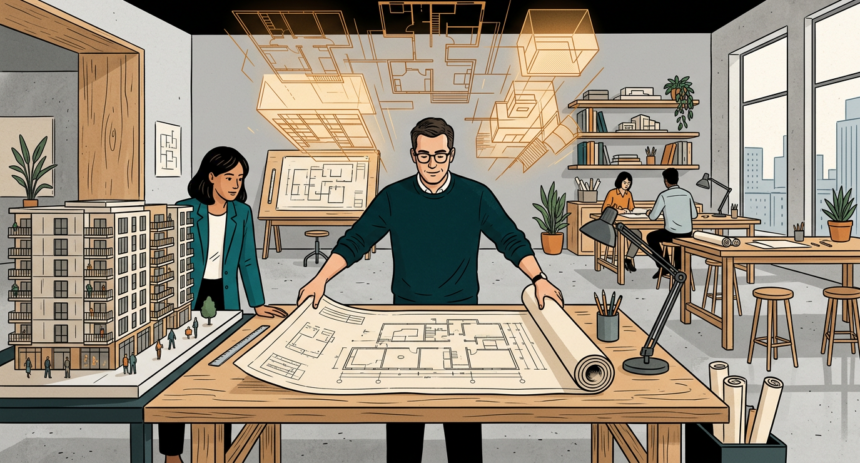
The San Francisco company launched out of stealth with $17M led by Andreessen Horowitz, joined by SV Angel, XYZ, Zigg Capital and others. Dream builds models that generate building designs, and it acts as architect of record on the plans it sells, meaning it carries the liability rather than handing software to a firm and walking away.

Founders Andy Elder and Arjun Mathur both came out of Palantir, where Elder led product design and Mathur served as senior vice president of the private sector business. Former Okta and Siemens engineers round out the team.

Blueprints, not a design tool

Dream is not selling seats. It delivers ready-to-use plans to construction and architecture firms, and says it already supports 10 projects in California and Texas worth a combined $20M.

The models were trained on data covering roughly 100M square feet of US real estate, spanning commercial buildings, apartments and single-family homes. The workflow starts with site analysis and operational constraints, produces a layout, then resolves component-level detail.

Iteration is the target. Adding a cooling system to a server hall normally forces changes to wiring and ventilation; Dream says its models propagate that kind of revision automatically, and can adapt an existing retail design to a new city’s building codes.

The hallucination problem is literal

Elder’s framing is the sharpest part of the pitch: a hallucination in a language model is a typo, but a hallucination in a building is a structural fault. Dream stores plans in a custom schema designed to make architectural calculations verifiable, the only way an insurer or city inspector accepts machine-generated drawings.

That constraint is what makes construction hard to automate and valuable to win.
Thrive Holdings banks $2B to wire AI into legacy businesses
Gudea banks $7M to forecast which stories go viral
Fluidstack draws Pentagon interest for a $5B supply-chain loan
AP Ventures closes a €269M fund for industrial hardware
Naboo buys UK events agency pro-ven and becomes Naboo UK overnight
TAGGED:AI designAndreessen Horowitzconstruction techDreamproptechseed funding
SOURCES:SiliconANGLETech in Asia
Share This Article
Facebook Copy Link Print
Previous Article Group14 picks Sagunto for a 10 GWh silicon anode plant
Next Article Fronted raises €17M to fold cross-border hiring into one platform

Get Some Gear


Quick Links

  • News
  • Features
  • Spotlight
  • Newsletter
  • Store

About Techflier

  • About Techflier
  • Services
  • Contact Us
  • Privacy
  • Legal

Indices

TechflierTechflier
Follow US
© 2026 Techflier. All Rights Reserved.
Welcome Back!

Sign in to your account

Username or Email Address
Password

Lost your password?