Pallet handling is one of the least glamorous jobs in a warehouse and one of the hardest to automate, because the boxes keep changing. Tutor Intelligence has raised $75M to argue that robots should simply learn each new item.
Two robots, one model family
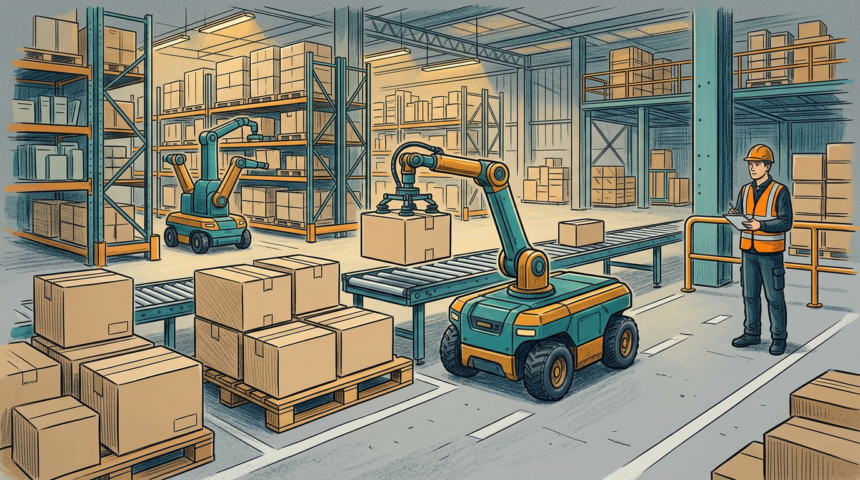
The Boston company sells Cassie, a mobile arm that unloads packages from pallets and loads containers at up to 18 items a minute, using a vacuum gripper rated above 50 pounds on a four-wheeled base. Its sibling Sonny carries two arms, picks items from shelves and packs them, relying on time-of-flight and stereo cameras for depth. Historically, teaching an arm a new product meant manual coding. Tutor’s models pick up fresh package types on their own.
Why the Series B
Andreessen Horowitz led the round, announced with the company’s public launch. Tutor teaches new tasks in a facility holding more than 100 robots, where human operators demonstrate a motion on a remote-controlled unit and the model learns by imitation. Chief executive Josh Gruenstein argues that Sonny’s manufacturability makes it suitable well beyond logistics, pointing to assembly and equipment maintenance as the next targets.
Pricing is the wedge
Rather than large upfront purchases, Tutor charges by usage, which lowers the barrier for mid-sized sites. The company says the number of facilities running its robots has nearly quadrupled in a year. It is the same argument competitors such as Ultra Robotics and Eden Robotics have used to win warehouse floors, and the market is now crowded with well-funded arms vendors.
The question for investors is whether the foundation-model approach keeps retraining costs low enough to compete with fixed automation on high-volume, low-variety lines.