
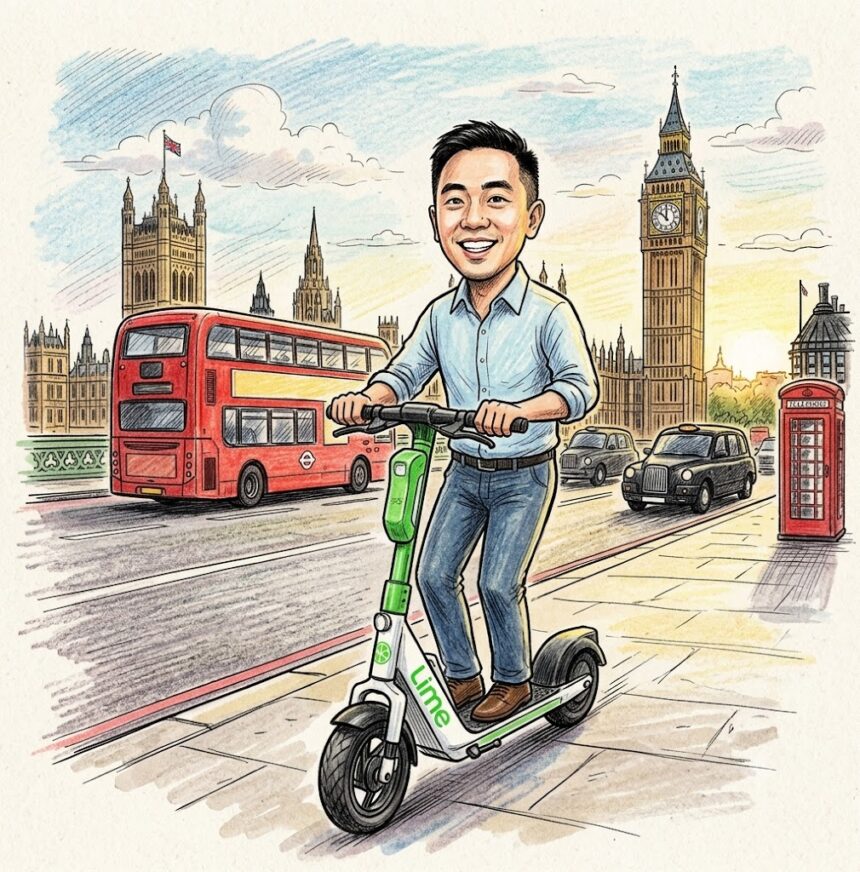
Fresh off a Nasdaq debut that valued the company at $1.7 billion, Lime CEO Wayne Ting is setting ambitious targets for the UK market — starting with getting the company’s e-bikes into every single London borough.
Speaking in an interview following Lime’s IPO last week, Ting said the company wants to operate across all 33 London boroughs, up from the 17 where it currently has a presence. The expansion push comes as Lime faces infrastructure constraints that are limiting its growth in one of its most important markets.
“We would love to serve every borough in London,” Ting said. “The reason why somebody may want to use Lime in the City of London is the same reason they want to use Lime in the outer boroughs — they want fast, affordable, green transportation.”
Lime went public on the Nasdaq on July 1 under the ticker LIME, raising $167 million in its IPO. Shares closed up 8% on the first day, reflecting investor appetite for micromobility as cities worldwide push for sustainable transit alternatives. Uber, an early backer, remains a significant shareholder.
Since its Nasdaq debut on July 1, Lime shares have continued to trade above the IPO price, signaling that investors see the micromobility sector as a rare growth story in an otherwise cautious market. Uber — which backed Lime early and integrates Lime rentals directly into its app — stands to benefit from the company’s expansion without carrying the operational risk on its own balance sheet. The IPO has given Lime a public-market currency to fund fleet expansion and infrastructure investments, while giving Wall Street a pure-play bet on the shift away from car-centric urban transport.
The geographic expansion hinges on solving two bottlenecks: bike parking infrastructure and protected bike lanes. Lime has already funded 930 new parking bays across London since January at a cost of £760,000, bringing its total contribution to 3,250 bays. But Ting acknowledged the infrastructure hasn’t kept pace with demand.
“There has been a huge growth in popularity of bikes in London but our infrastructure hasn’t kept pace,” he said. “Creating enough parking spaces to ensure people can go where they want to go is super critical.”
Lime is now exploring deals with private businesses that own kerbside parking space, offering to cover implementation and maintenance costs in exchange for dedicated parking — a strategy Ting pitched as a win-win that drives foot traffic.
The company also faces regulatory friction. Lime recently lost its operating contract in Hounslow, creating a geo-fencing gap where bikes shut down at the borough border — a source of frustration for riders. Ting said the situation highlights the need for London-wide regulations rather than borough-by-borough agreements.
On the technology side, Lime is deploying AI that authenticates rider-uploaded parking videos to ensure bikes are left in acceptable locations. The company is also piloting an incentive program offering free minutes to riders who start trips on badly parked bikes, helping redistribute the fleet. Since January, Lime says overcrowding in parking bays has dropped 60%.
The Tube strike in early September provided a stress test for the network, with Lime seeing a record ridership week in London and a 69% spike in trips on the final strike day. Ting credited the company’s 400 on-street London staff for keeping operations running through the surge.
With fresh public-market capital and a clear expansion roadmap, Lime’s post-IPO strategy is playing out in real time on London’s streets. The question is whether the city’s infrastructure and regulatory framework can keep up with the company’s ambitions.
Source: The Times and Yahoo News UK / Evening Standard