
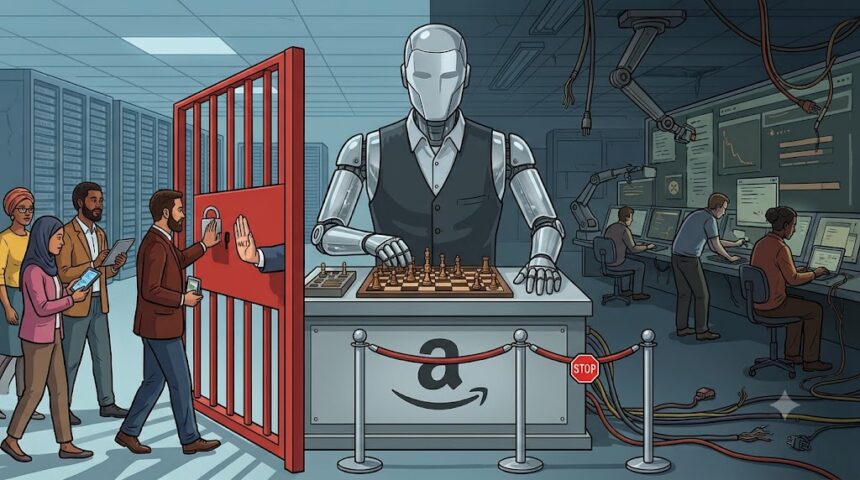
Two decades after launching one of the internet’s most controversial labor experiments, Amazon is quietly pulling the plug — at least for newcomers. On July 30, the company will stop accepting new customers for Mechanical Turk, the crowdsourcing platform that once promised to reshape how humans and computers work together.
Existing customers will still be able to use the service, but Amazon has made clear the platform is entering maintenance mode. No new features are planned, and the writing on the wall suggests Mechanical Turk’s days are numbered.
Launched in 2005, Mechanical Turk was built on a simple premise: create a marketplace where people get paid small amounts to complete tasks that computers couldn’t yet handle. Those tasks — everything from identifying objects in photos to analyzing text sentiment — became known as “micro-work,” and the platform quickly grew into a backbone for data labeling and quality control across the tech industry.
But the platform also became a flashpoint for debates about labor ethics. Critics argued the sub-minimum-wage payments and lack of benefits turned Mechanical Turk into a poster child for digital exploitation. And in a twist straight out of science fiction, the laborers themselves eventually turned to AI to automate their work.
The irony runs even deeper. Amazon had repurposed Mechanical Turk in 2018 as a data annotation service for its SageMaker AI platform, enabling companies to train neural networks. But the rise of more sophisticated AI tools gradually made the need for human-in-the-loop micro-work less obvious. If workers themselves were using AI to complete the tasks, what was the point of keeping humans in the chain at all?
For a company with a $2 trillion market cap and over $620 billion in annual revenue, Mechanical Turk was never more than a rounding error. Amazon’s core business engine — AWS, e-commerce, advertising and now a massive AI infrastructure buildout — has long eclipsed the crowdsourcing experiment. The shutdown reflects a broader pattern under CEO Andy Jassy: cutting non-core products and doubling down on high-growth, high-margin bets. Last quarter alone, AWS generated more operating income than MTurk has likely brought in over its entire two-decade history.
Mechanical Turk also had a quieter role as a behind-the-scenes enabler for startups that marketed themselves as AI-driven but quietly relied on human workers to handle the heavy lifting — what some critics called the “fake it till you make it” approach to artificial intelligence.
The reaction on Reddit was muted but telling. Longtime users suggested the platform effectively died years ago, driven into the ground by bots and fraud. With Amazon no longer investing in new features, it’s only a matter of time before the servers get turned off entirely.
For the startup ecosystem, the shutdown marks the end of an era. Mechanical Turk was one of the first platforms to make on-demand human labor accessible at scale. Its decline — driven by the very AI it was supposed to enable — is a fitting coda for a service that began life as a chess-playing hoax in the 18th century.
Source: TechCrunch